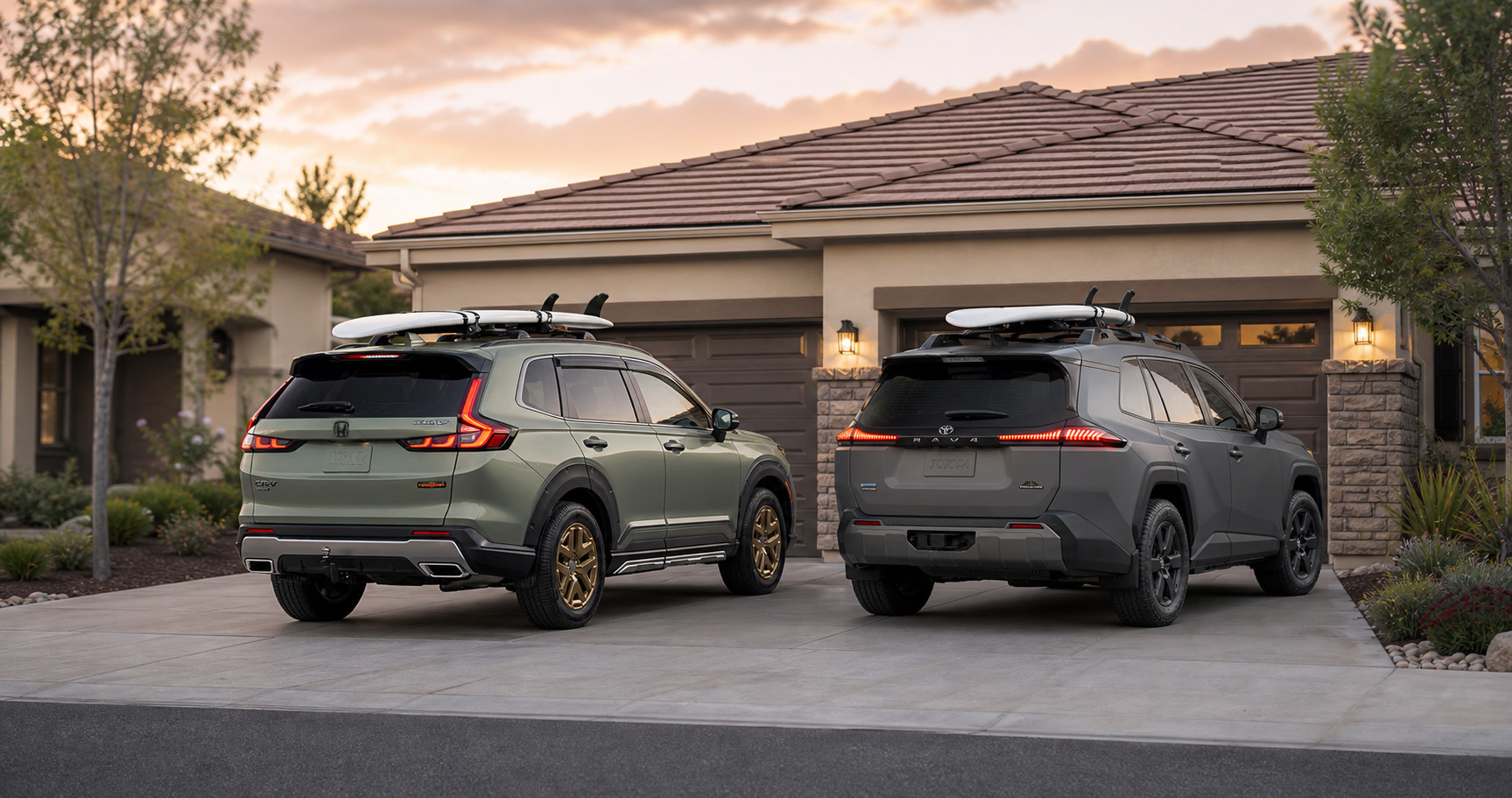
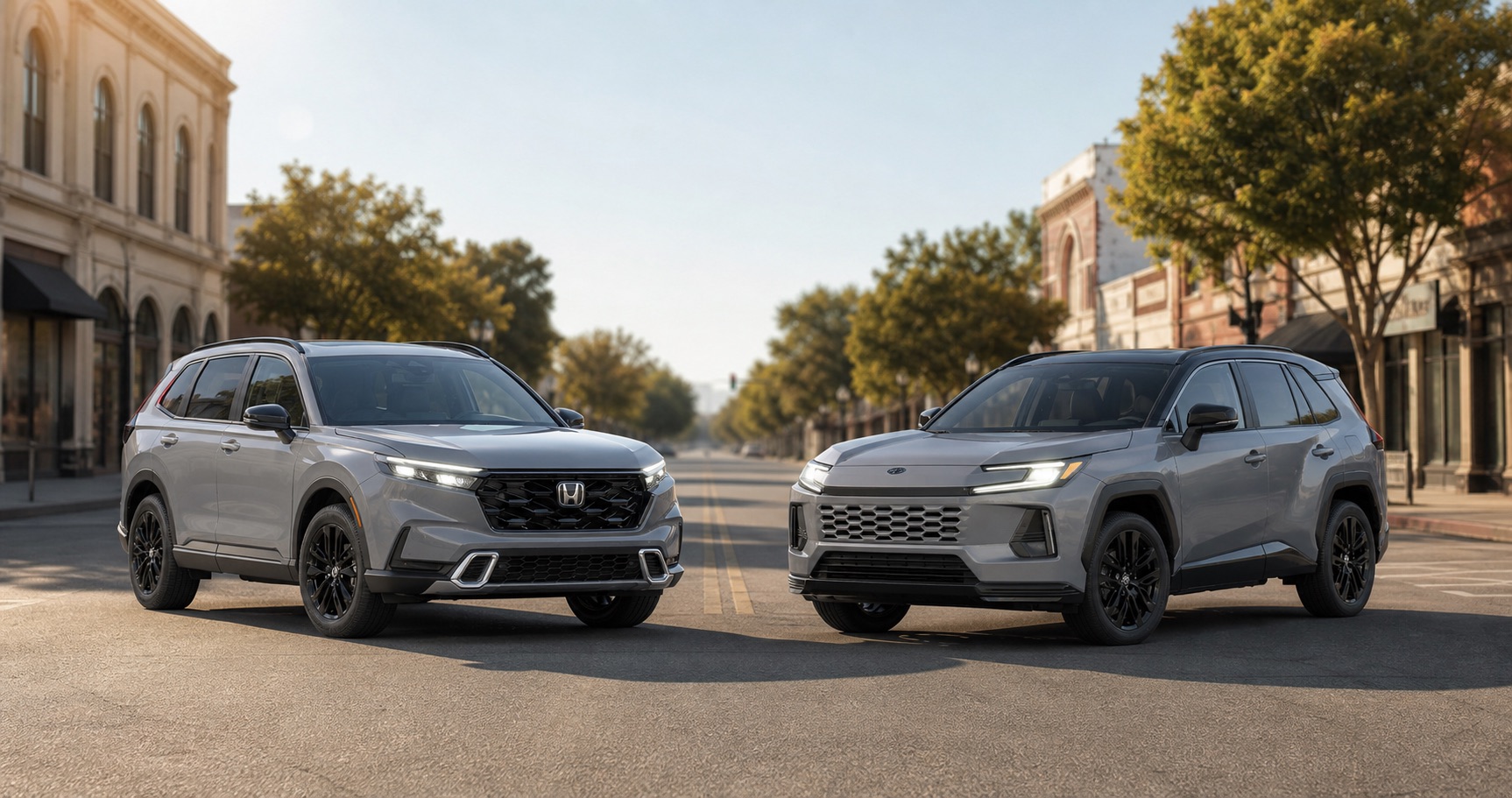
2026 Honda CR-V and redesigned Toyota RAV4 parked side by side on a paved overlook at sunset, with rolling hills, a calm waterline, and soft golden-hour lighting highlighting both SUVs from a front three-quarter angle


2026 Honda CR-V vs Toyota RAV4

Which SUV actually fits your daily driving in the Central Valley? This comparison breaks down comfort, space, efficiency, and everyday usability so you can choose the one that makes the most sense long term.


On paper, the 2026 Honda CR-V and Toyota RAV4 land in the same conversation for a reason. They cover the core needs most compact SUV buyers have—efficiency, space, and everyday flexibility. The difference shows up once you think about how that vehicle actually gets used throughout the week.

Working with drivers around Tracy and the surrounding areas, that’s usually where the decision starts to shift. A typical week might mean a short drive through town, a longer stretch out toward Modesto, or unpredictable traffic moving between places like Brentwood and Discovery Bay. It’s not one type of driving—it’s a mix, and that mix tends to highlight comfort, space, and how easy a vehicle feels over time.

The RAV4 leans into efficiency and a slightly more structured, upright feel behind the wheel. The CR-V approaches things differently. It smooths out the drive, opens up the cabin, and keeps everything feeling more relaxed and predictable as the miles add up. That kind of difference doesn’t always stand out in a quick test drive, but it becomes more obvious once it’s part of a routine.

This comparison looks at the 2026 Honda CR-V vs Toyota RAV4 through that lens. We’ll break down pricing, performance, interior space, technology, and safety—not just by what they offer, but by what those differences actually mean once you’re driving it every day.


View Quick Answers About 2026 Honda CR-V vs Toyota RAV4

Which SUV is better for daily driving?
The CR-V tends to feel smoother and more consistent in everyday use, especially in traffic and longer drives, while the RAV4 delivers a firmer, more responsive feel.


Does the RAV4 have more horsepower than the CR-V?
Yes. The RAV4 hybrid produces more combined horsepower, giving it a quicker initial response compared to the CR-V’s more controlled power delivery.


Which SUV is more comfortable inside?
The CR-V offers more passenger space and a more open cabin feel, which makes it more comfortable over longer drives.


Is the Honda CR-V hybrid efficient?
Yes. The CR-V hybrid delivers strong fuel economy while maintaining smooth and predictable performance in everyday driving conditions.


Which SUV is easier to use day to day?
The CR-V stands out for its straightforward layout and intuitive controls, making it easier to operate without distraction.


Does the RAV4 offer more features?
Depending on trim, the RAV4 includes larger screens and additional features like ventilated seats and a panoramic roof.


Which SUV is better for families?
The CR-V is often the better fit due to its rear seat space, cargo usability, and overall comfort across longer trips.


Do both SUVs offer all-wheel drive?
Yes. Both models offer AWD, though availability and packaging differ by trim.


What Does Car and Driver Say About the CR-V and RAV4?

A third-party look at how these two compact SUVs compare when tested, ranked, and lived with.


CAR AND DRIVER REVIEW

2026 Honda CR-V

10 / 10 Rating

In Car and Driver’s CR-V review, the CR-V is recognized as one of the most well-rounded compact SUVs available. It earns that rating by doing the fundamentals exceptionally well—ride quality, interior space, and overall usability all come together in a way that feels complete rather than pieced together.

They call out how smooth and quiet it is in everyday driving, along with a cabin that feels more refined than most competitors. That lines up with what we see here—once drivers spend time in the CR-V, the difference tends to show up in how relaxed and easy everything feels behind the wheel.

It’s a strong example of a vehicle that doesn’t rely on standout specs. Instead, it consistently delivers across the areas that matter most once it becomes part of a daily routine.

CAR AND DRIVER REVIEW

2026 Toyota RAV4

8.5 / 10 Rating

In Car and Driver’s RAV4 review, the RAV4 earns strong marks for efficiency and practicality, especially in hybrid form where fuel economy stands out. It continues to be a reliable choice for buyers who prioritize MPG and long-term durability.

They also point to its more traditional SUV feel and available capability, which gives it a different personality compared to more comfort-focused competitors.

At the same time, the review notes a firmer ride and a cabin that doesn’t feel quite as refined. When drivers compare the two back to back, that difference in comfort and overall driving feel tends to be one of the first things they notice.


Ready to See the Honda CR-V for Yourself?

The CR-V stands out where it matters most in daily driving. Explore hybrid models or break down trims to find the version that fits your routine.


2026 Honda HR-V vs Toyota C-HR: Full Comparison


Price & Trim Levels
Price & Trim Levels Comparison
Category 2026 Honda CR-V 2026 Toyota RAV4
MSRP Range*
Base to Top Trims
$30,920 – $42,550 $31,900 – $43,300
Trim Levels LX
EX
Sport Hybrid
EX-L
TrailSport Hybrid
Sport-L Hybrid
Sport Touring Hybrid
LE
SE
XLE Premium
Woodland
XSE
Limited
Drivetrain Availability FWD standard • Real Time AWD™ available • AWD available across the lineup FWD on LE, SE, XLE Premium • AWD on Woodland, XSE, Limited


At a glance, the 2026 Honda CR-V and 2026 Toyota RAV4 sit in a very similar price range, so most buyers won’t choose one over the other based on MSRP alone. The real difference shows up in how each lineup is structured and how easy it is to land on the right trim without overcomplicating the decision.

The CR-V keeps things clear and consistent. Each trim builds logically, so shoppers can move from a well-equipped base model into hybrid options and more refined trims without feeling like they’re jumping between completely different versions. That makes it easier to match the vehicle to your daily routine instead of sorting through overlapping packages.

The RAV4 does a good job offering more variation in trim personality, especially with options like the Woodland model that lean into a more outdoors-focused look. For some buyers, that added variety is a plus, but it can also make the lineup feel less straightforward when comparing features and value side by side.

Where the CR-V really stands out is how naturally the hybrid models fit into the lineup. It’s easier to step into a fuel-efficient setup without needing to move all the way to the top trim. On top of that, available AWD across more trims gives drivers added flexibility without forcing a specific configuration.

From what we see working with drivers around Tracy every day, the CR-V tends to make the buying process simpler and the ownership experience easier to live with long term.

Performance & Fuel Economy
Performance & Fuel Economy Comparison
Category 2026 Honda CR-V 2026 Toyota RAV4
Powertrain Type 1.5L Turbocharged 4-Cylinder Gas Engine • 2.0L Two-Motor Hybrid System 2.5L Dynamic Force 4-Cylinder Hybrid System
Total Horsepower 190 hp (Gas) • 204 hp (Hybrid) 236 combined net hp
Torque 179 lb-ft (Gas) • 247 lb-ft (Hybrid) 170 lb-ft max electric motor torque
Transmission Continuously Variable Transmission (Gas) • Two-Motor Hybrid System Electronically Controlled Continuously Variable Transmission (ECVT)
Drivetrain* FWD standard • AWD available FWD or AWD depending on trim
Drive Modes Normal • Econ • Snow (Gas) • Sport • Normal • Econ • Snow (Hybrid) Sport • Eco • Normal • EV • Trail • Snow
Fuel Economy City / Hwy / Combined* Gas FWD: 28 / 33 / 30 MPG
Gas AWD: 27 / 31 / 29 MPG
Hybrid FWD: 43 / 36 / 40 MPG
Hybrid AWD: 40 / 34 / 37 MPG or 38 / 33 / 35 MPG
FWD: 47 / 40 / 43 MPG
AWD: 43 / 37 / 41 MPG or 41 / 35 / 38 MPG


The numbers here tell a familiar story, but how they show up behind the wheel feels different. The 2026 Toyota RAV4 leads with higher combined horsepower, and you can feel that right away when pulling into faster traffic or accelerating from a stop. It responds quickly and has a bit more initial urgency, which some drivers prefer.

The 2026 Honda CR-V takes a more measured approach. Its hybrid system doesn’t chase that same quick hit of power—instead, it delivers torque in a smoother, more controlled way. That matters more than it sounds, especially in everyday driving where constant stops, merges, and uneven pacing are the norm. The CR-V feels composed rather than reactive.

Efficiency stays close across both SUVs. The RAV4 posts slightly higher peak MPG figures, particularly in front-wheel drive form. The CR-V hybrid, though, keeps pace while maintaining a more consistent feel in mixed driving, especially when AWD is in play. It doesn’t feel like you’re trading refinement to get there.

Looking at how these two actually perform over time, the difference comes down to feel. The RAV4 leans into responsiveness and output, while the CR-V prioritizes smoothness and predictability—something many drivers end up valuing more once the daily routine settles in.

Exterior Dimensions
Exterior Dimensions Comparison
Category 2026 Honda CR-V 2026 Toyota RAV4
Overall Length 184.8 In 181.0 In – 182.0 In
Overall Width 73.5 In 73.0 In – 74.0 In
Overall Height 63.4 In – 64.1 In 66.5 In
Wheelbase 106.3 In 105.9 In
Ground Clearance 7.8 In – 8.2 In 8.1 In – 8.5 In
Turning Diameter 37.0 Ft – 37.3 Ft 36.0 Ft


Size differences between the 2026 Honda CR-V and 2026 Toyota RAV4 look small on paper, but they shape how each SUV feels in everyday use. The CR-V runs slightly longer with a more extended wheelbase, and that added footprint shows up as a more stable, planted feel on the road. It tracks smoothly at speed and feels less busy over uneven pavement, which becomes noticeable during longer drives.

The RAV4 takes a taller, more upright approach. That extra height and slightly higher ground clearance give it a more traditional SUV stance and a bit more confidence on rougher surfaces. It’s a good fit for drivers who like that elevated feel or plan to spend time on less developed roads.

Where the CR-V quietly separates itself is balance. It stays low enough to feel controlled through turns and parking situations, but still offers enough clearance to handle everyday conditions without concern. That makes it easier to maneuver in tighter spaces while keeping a composed ride once you’re moving.

The RAV4 does hold a slight edge in turning diameter, which can help in very tight maneuvers. Still, the CR-V’s longer, more settled proportions tend to feel more natural across a wider range of driving situations, especially once daily routines take over.

Interior Dimensions
Interior Dimensions Comparison
Category 2026 Honda CR-V 2026 Toyota RAV4
Seating Capacity 5 5
Passenger Volume 103.5–106.0 Cu Ft 98.9 Cu Ft
Headroom (Front/Rear) 38.2–40.0 / 38.2 In 36.7 / 36.7 In
Legroom (Front/Rear) 41.3 / 41.0 In 41.0 / 37.8 In
Shoulder Room (Front/Rear) 57.9 / 55.9 In 57.0 / 56.4 In
Hip Room (Front/Rear) 55.6 / 52.6 In 55.3 / 49.6 In
Cargo Volume (Rear Cargo Area) 34.7–39.3 Cu Ft 36.6–37.8 Cu Ft


Inside the cabin is where the 2026 Honda CR-V starts to feel noticeably different from the 2026 Toyota RAV4. On paper, both seat five, but the CR-V gives passengers more room to actually spread out. Higher overall passenger volume, along with added rear legroom, makes a real difference when adults are riding in the back or when trips run longer than a quick drive across town.

The rear seat is where that gap shows up most clearly. The CR-V provides over three extra inches of rear legroom, which changes how comfortable the space feels for passengers who aren’t just along for a short ride. It also makes everyday tasks like installing car seats or shifting passengers around feel less cramped.

Headroom follows a similar pattern. The CR-V offers more space both front and rear, giving the cabin a more open feel rather than the slightly tighter, more enclosed layout you notice in the RAV4.

Cargo space stays competitive between both SUVs, with the RAV4 holding a slight edge in maximum capacity depending on configuration. Still, the CR-V balances passenger comfort and cargo usability more effectively, which tends to matter more once the vehicle becomes part of a daily routine rather than just a spec comparison.

Interior & Technology Features
Interior & Technology Comparison
Feature 2026 Honda CR-V 2026 Toyota RAV4
Touchscreen Size 9-In 10.5-In or 12.9-In
Digital Driver Display 7-In or 10.2-In 12.3-In
Wireless Apple CarPlay / Android Auto
Premium Audio System ✔ (Up to 12 speakers) ✔ (Up to 9 speakers)
Wireless Phone Charging
USB-C Charging (Front & Rear)
Household Power Outlet
Dual-Zone Climate Control
Rear Air Vents
Heated Front Seats
Ventilated Front Seats
Heated Rear Seats
Power Driver Seat
Power Passenger Seat
Moonroof / Glass Roof ✔ (Moonroof) ✔ (Panoramic Available)
Hands-Free Power Liftgate
Remote Engine Start


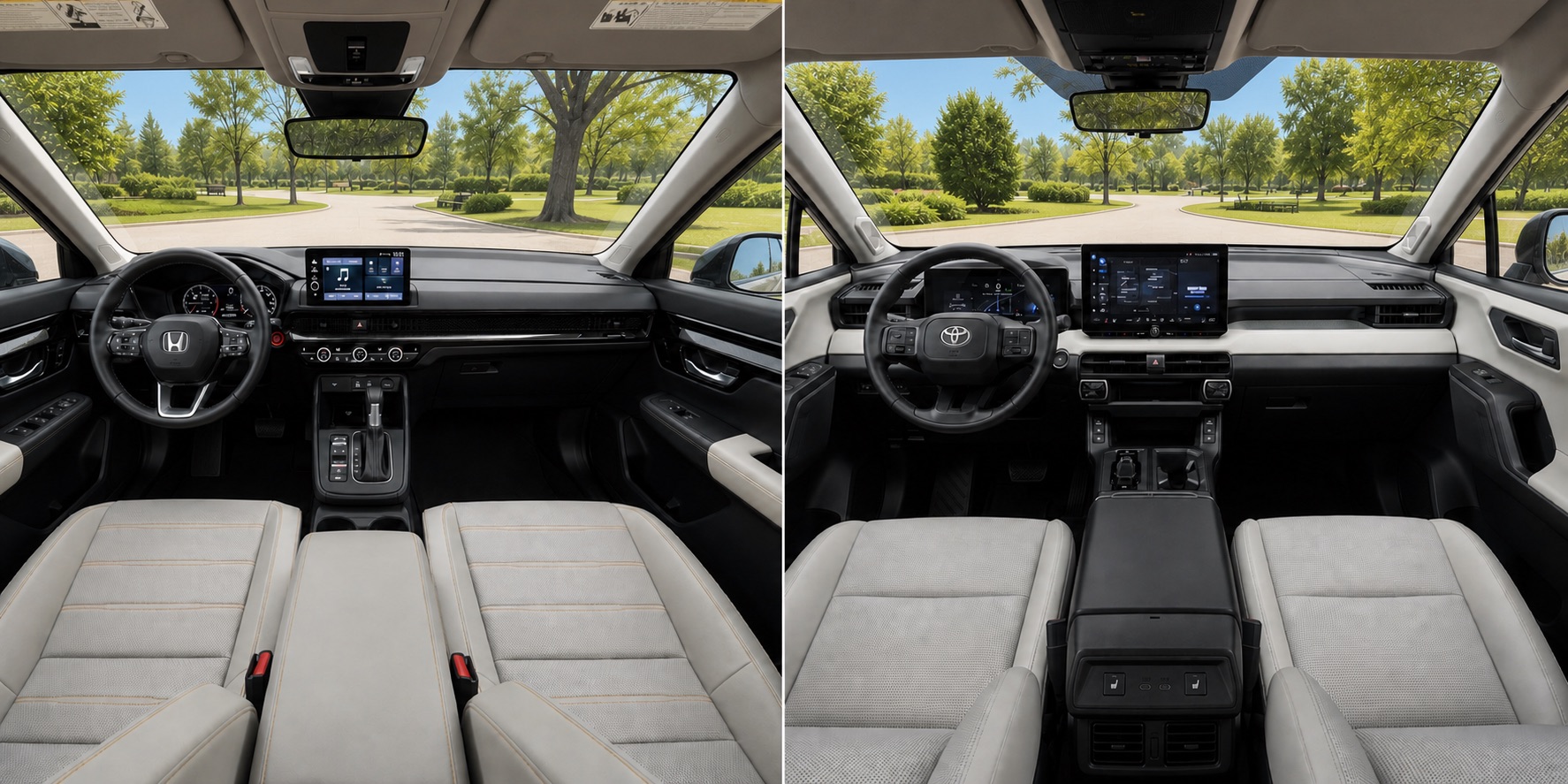
Technology and comfort features look similar at a glance, but how they’re delivered creates a different experience inside the 2026 Honda CR-V and 2026 Toyota RAV4. The RAV4 leans into larger screens and more feature availability on higher trims, including options like ventilated seats and a panoramic roof. For buyers who prioritize bigger displays or added luxury touches, that can stand out quickly.

The CR-V takes a more balanced approach. Instead of focusing on size or excess, it centers on usability. The touchscreen, controls, and layout feel straightforward and easy to interact with, which matters more over time than an extra inch or two of screen space. You’re not digging through menus or relearning the system—it just works the way you expect it to.

Audio is one area where the CR-V quietly pulls ahead, offering a higher speaker count for a fuller sound experience. At the same time, it covers all the essentials that actually get used every day, including wireless smartphone connectivity, charging access for both rows, and a clean, uncluttered cabin design.

The RAV4 does offer a few extra features depending on trim, but the CR-V focuses on making everything feel more intuitive and easier to live with. For most drivers, that simplicity ends up being the feature that matters most once the vehicle becomes part of a daily routine.

Safety & Driver Assistance
Safety & Driver Assistance Comparison
Feature 2026 Honda CR-V 2026 Toyota RAV4
Full Safety Suite Honda Sensing® Toyota Safety Sense™ 4.0
Automatic Emergency Braking
Adaptive Cruise Control*
Lane Keeping Assistance*
Traffic Jam Assist* Available
Blind Spot Monitoring
Rear Cross-Traffic Alert
Parking Assistance
360° Camera -
Rearview Camera
Automatic High Beams
Airbag Coverage ✔ Multi-angle airbag system ✔ 8-airbag system


Both the 2026 Honda CR-V and 2026 Toyota RAV4 come well-equipped when it comes to safety, and either one covers the fundamentals most drivers expect. Systems like automatic emergency braking, adaptive cruise control, lane keeping assistance, and blind spot monitoring are standard across both lineups, so there’s no gap when it comes to core protection.

Where the CR-V starts to separate itself is in how consistently those features show up and how they function in daily driving. Honda Sensing® feels more integrated into the driving experience, with smoother inputs and less abrupt intervention. Features like Traffic Jam Assist come standard rather than being tied to specific trims, which matters for drivers dealing with regular stop-and-go traffic.

The RAV4 does offer a few extra features depending on configuration, including an available 360-degree camera and broader availability of certain advanced tools. For buyers who want the most visual awareness features, that can be a strong advantage.

From a day-to-day perspective, though, the CR-V focuses on making driver assistance feel natural rather than intrusive. It’s the kind of system that supports you without constantly reminding you it’s there, which tends to make a bigger difference over time than simply adding more features to the list.


Interior view of a 2026 Honda CR-V showing the driver’s seat, steering wheel, digital display, center touchscreen, and dashboard with a desert landscape visible through the windshield


Choosing the Right Compact SUV for Your Daily Routine

After comparing the 2026 Honda CR-V and Toyota RAV4 across pricing, performance, space, and technology, the differences come down to how each SUV fits into real life—not just how they look on paper. The RAV4 brings strong efficiency numbers, a slightly more responsive feel, and a wider range of trim personalities, which can appeal to buyers looking for a more defined style or added features in specific configurations.

The CR-V, on the other hand, focuses on consistency. It delivers a smoother ride, more usable interior space, and a layout that feels easier to live with day after day. From commuting and errands to longer drives, it keeps things simple without sacrificing capability. That balance is what tends to stand out most once the vehicle becomes part of a regular routine.

For many drivers, the decision comes down to priorities. If quick acceleration or a more rugged design stands out, the RAV4 makes sense. If comfort, flexibility, and overall ease matter more over time, the CR-V often feels like the more natural fit.

At Tracy Honda, we help drivers take that next step by experiencing the CR-V in person, so the differences become clear in a way no comparison alone can fully capture.


Ready to See the Honda CR-V for Yourself?

The CR-V stands out where it matters most in daily driving. Explore hybrid models or break down trims to find the version that fits your routine.


FAQ: 2026 Honda CR-V vs Toyota RAV4

Which is better for everyday driving: the 2026 Honda CR-V or Toyota RAV4?

The CR-V tends to feel easier to live with day to day thanks to its smoother ride, more open cabin, and consistent driving behavior. The RAV4 offers a firmer, more upright feel that some drivers prefer, but the CR-V’s balance usually fits a wider range of daily routines.

Which SUV has better fuel economy?

The RAV4 hybrid posts slightly higher peak MPG figures, especially in front-wheel drive trims. The CR-V hybrid stays very close while delivering a smoother, more consistent feel in mixed driving, which matters just as much over time.

Which has more interior space: CR-V or RAV4?

The CR-V offers more passenger volume and significantly more rear legroom, which makes a noticeable difference for back seat comfort. It also feels more open overall, especially on longer drives or when carrying multiple passengers.

Which SUV is more comfortable for long drives?

The CR-V stands out for long-distance comfort. Its smoother ride quality, quieter cabin, and more supportive seating make it easier to stay comfortable over time compared to the firmer feel of the RAV4.

Which SUV has better cargo space?

Both SUVs offer similar cargo capacity, but the CR-V is easier to use thanks to its wider opening and flatter load floor. That makes loading bulkier or multiple items more straightforward in everyday situations.

Which SUV feels quicker or more powerful?

The RAV4 hybrid has higher peak horsepower and feels more immediate when accelerating. The CR-V focuses more on smooth, steady power delivery, which often feels more controlled in everyday driving conditions.

Which SUV has better technology features?

The RAV4 offers larger available screens and a few additional premium features depending on trim. The CR-V focuses on ease of use, with a simpler layout and controls that are easier to interact with during daily driving.

Which SUV is better for commuting?

The CR-V is generally the better fit for commuting. Its smoother ride, quieter cabin, and more relaxed driving feel make it easier to handle daily traffic and longer stretches behind the wheel.

Which SUV offers better value overall?

Both offer strong value, but the CR-V stands out for how balanced it is across comfort, space, efficiency, and usability. It delivers a more consistent experience across trims without requiring buyers to move into higher price points to get the features that matter most.

Where can I compare the 2026 Honda CR-V and RAV4 near me?

Drivers from Manteca, Lathrop, Tracy Hills, Mountain House, Patterson, Discovery Bay, Brentwood, and Modesto often visit Tracy Honda to compare the CR-V in person and see how it fits into their daily routine. It’s one thing to look at specs, but getting behind the wheel—especially with Central Valley commuting conditions in mind—makes the differences much clearer.


Why Drivers Choose Tracy Honda

At Tracy Honda, we focus on helping drivers make decisions that actually hold up once the vehicle becomes part of daily life. Comparing the 2026 Honda CR-V and Toyota RAV4 isn’t just about features—it’s about how each one fits your routine, your commute, and the way you use your vehicle across the Central Valley.

We’re proud to serve drivers from Manteca, Lathrop, Tracy Hills, Mountain House, Patterson, Discovery Bay, Brentwood, and Modesto. That local perspective matters. Driving here isn’t one pattern—it’s a mix of short trips, longer highway stretches, and unpredictable traffic where comfort, space, and ease of use start to matter more than specs on paper.

Our team takes the time to break those differences down in a way that makes sense. We’ll walk through how the CR-V actually feels on the road, how the interior works in real situations, and which trim level fits your day-to-day needs. When you’re ready, the best way to decide is to experience it for yourself and see how naturally it fits your routine.


DISCLAIMERS:
*MSRP does not include destination and handling fees, taxes, title, or additional dealer fees. Actual dealer price may vary.
*EPA-estimated mileage. Actual results will vary based on driving conditions, vehicle maintenance, driving habits, and other factors.
*Horsepower and torque figures are based on manufacturer estimates and may vary by configuration and drivetrain.
*All-wheel drive availability varies by trim level and configuration. See dealer for full details.
*Driver-assist and safety features are not substitutes for attentive driving. Systems may not detect all objects or conditions. Always monitor road conditions and control the vehicle.