
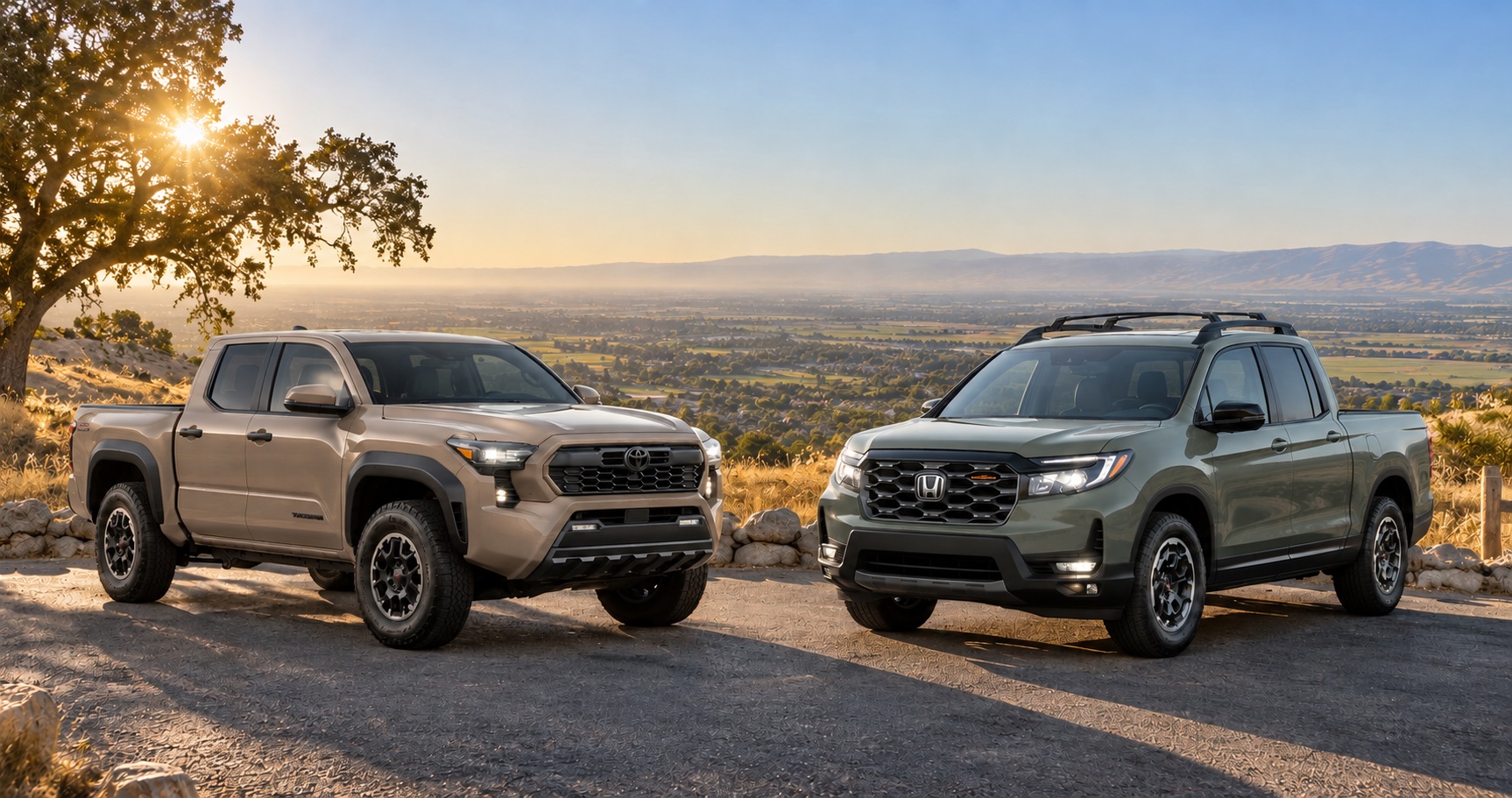
2026 Toyota Tacoma and Honda Ridgeline overlooking the Tracy, CA area

2026 Midsize Truck Comparison

Honda Ridgeline vs Toyota Tacoma

Everyday Comfort & Clever Bed Utility—or More Towing, Configurations & Trail Hardware?


The 2026 Honda Ridgeline and 2026 Toyota Tacoma overlap in size and pickup purpose, but this comparison makes sense because they approach midsize-truck ownership differently. The Ridgeline concentrates on one well-equipped crew-cab/AWD formula, while the Tacoma stretches from simpler work-oriented configurations to higher-output hybrid and specialized trail setups.

That contrast fits the Greater Tracy Area especially well. A truck here may spend weekdays on I-205 or I-580, handle school or jobsite runs and home-project errands, then carry bikes, camping gear or a trailer toward Delta or foothill recreation on the weekend. The useful question is not which truck posts the biggest number; it is which set of tradeoffs matches the jobs that actually appear on your calendar.

That makes this less of a universal-winner comparison and more of a mission check. Tacoma gives buyers more ways to tune price, bed length, powertrain and off-road capability. Ridgeline concentrates its strengths in passenger comfort, easy bed access and low-friction daily use. The sections below separate those meaningful differences from the smaller ones so neither a maximum specification nor one convenience feature gets more weight than it deserves.


Start With Your Routine

Which Midsize Truck Deserves Your First Look?

Choose the priority that shapes your truck decision most. The result is a starting point, not a universal verdict; use the detailed comparison below to see whether that lean holds up across the rest of your routine.

Based on This Priority

Daily Comfort & Passenger Space

Start With the Honda Ridgeline

Who This Favors

Drivers whose truck is also the household commuter, passenger carrier or long-distance daily vehicle.

Why It Points Here

A unibody structure, four-wheel independent suspension, standard AWD and 36.7 inches of rear legroom give the Ridgeline a more daily-driver-focused foundation.

Also Compare

Tacoma remains worth a look if its higher towing ceiling or 4WD hardware will be used often enough to outweigh the cabin and ride priorities.

Shop the Ridgeline
Ridgeline vs Tacoma in 60 SecondsSeven differences most likely to shape your shortlist

What is the biggest Ridgeline vs Tacoma difference?
Construction philosophy. The Ridgeline uses a unibody structure with independent suspension and standard AWD, while the Tacoma uses a body-on-frame truck platform with multiple rear-drive/4WD, cab, bed and suspension configurations.


Which truck can tow more?
Tacoma has the higher lineup ceiling at up to 6,500 pounds when properly configured. Every Ridgeline is rated up to 5,000 pounds. If your actual trailer stays well below that threshold, the difference may matter less than ride, cabin and bed usability.


Which has more payload?
The published lineup maximums are close: up to 1,583 pounds for Ridgeline and up to 1,705 pounds for Tacoma. Because payload changes by trim and equipment, the exact door-jamb payload label is more useful than treating the 122-pound peak gap as a universal advantage.


Which bed is more versatile?
They solve utility differently. Tacoma offers 5- and 6-foot bed choices plus available power and trail-focused equipment. Ridgeline standardizes a 5.3-foot bed and adds a dual-action tailgate, a 7.3-cu-ft lockable In-Bed Trunk and a wide flat floor between the wheel wells.


Which is better for passengers and commuting?
Ridgeline makes the stronger first case. Its rear seat lists 36.7 inches of legroom versus 33.7 inches for Tacoma Double Cab, and its unibody/independent-suspension layout is tuned around smoother everyday road behavior.


Is Ridgeline AWD the same as Tacoma 4WD?
No. Ridgeline uses torque-vectoring i-VTM4 all-wheel drive for automatic all-weather traction and has Snow, Sand and Mud modes. Tacoma offers traditional truck 4WD configurations with high/low range, and selected trims add locking-differential and trail-control hardware.


Which starts at a lower price?
Tacoma. Its lineup starts at $32,545, while Ridgeline Sport starts at $40,795 before Honda destination. But the Tacoma base figure can represent a simpler drivetrain/cab setup; the Ridgeline price already includes a five-passenger crew cab, V6, AWD and its core bed features.

Start With the Foundation

Unibody vs Body-on-Frame: Why These Trucks Feel Different Before the Specs Even Start

This is not a good-versus-bad distinction. It is the engineering choice that helps explain why the Ridgeline and Tacoma prioritize different kinds of truck ownership.

Honda Ridgeline

Unibody + Four-Wheel Independent Suspension

The body and structural shell work as one integrated unit. Paired with independent suspension at all four corners, that layout contributes to a calmer road ride, predictable handling and packaging flexibility that helps make the under-bed trunk possible.

Toyota Tacoma

Body-on-Frame TNGA-F Truck Platform

The cab and bed sit on a separate truck frame. Toyota combines that foundation with multiple suspension, cab, bed and 4WD configurations, giving Tacoma more room to specialize for towing, long-bed use and technical off-road work.

What This Means in Real Use

On pavement, the Ridgeline’s integrated structure and four-wheel independent suspension help it feel less busy and more passenger-focused than a traditional pickup. Tacoma’s body-on-frame layout, together with available low-range 4WD and specialized suspension hardware, leaves more room for heavier towing and trail-focused setups. Neither architecture wins every use case; the advantage depends on how often those differences reach your routine.


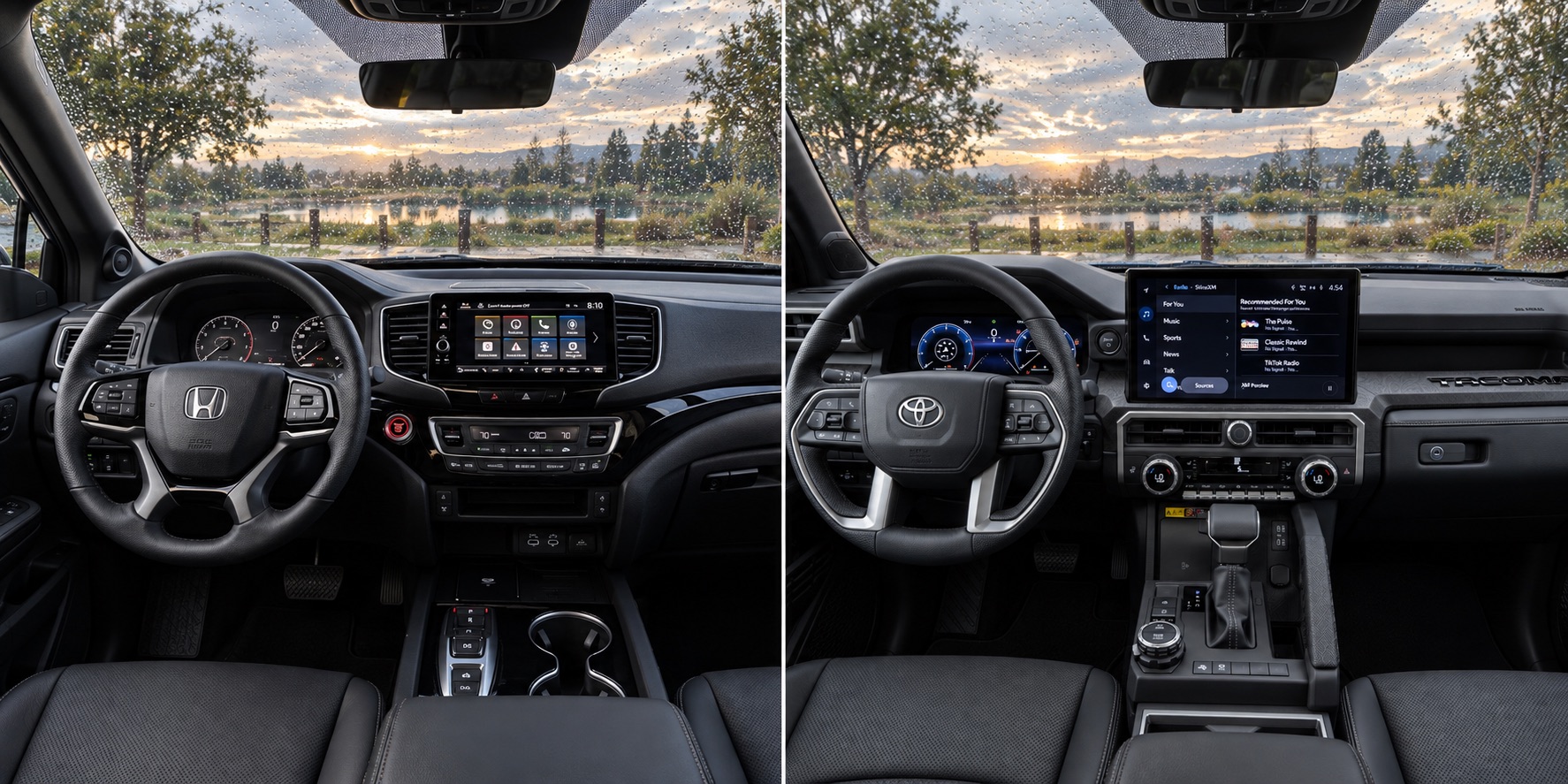
Honda Ridgeline and 2026 Toyota Tacoma interiors shown side by side on a rainy day

Compare the Tradeoffs

Ridgeline vs Tacoma by the Decisions That Change Truck Ownership

Use At a Glance as the baseline, then open the topics that match the truck jobs you care about most.

Select a Topic or Use Previous/Next

Start Here

Two Different Answers to the Midsize-Truck Job

The Ridgeline simplifies the formula around daily usability; Tacoma expands the formula around configuration and capability choice.

2026 Honda Ridgeline vs Toyota Tacoma at a Glance
Category2026 Honda Ridgeline2026 Toyota Tacoma
Design Priority
  • One standardized AWD crew-cab formula
  • Passenger-focused ride & cabin packaging
  • Built-in bed access & hidden storage
  • Multiple cabs, beds, drivetrains & powertrains
  • Higher towing & torque ceilings
  • Broader factory off-road specialization
Starting MSRP*$40,795
Sport; AWD crew cab, before $1,495 destination
$32,545
SR lineup entry; configuration varies
Core Power280 hp / 262 lb-ft
3.5L V6; 9-speed automatic
Up to 278 hp / 317 lb-ft gas
326 hp / 465 lb-ft i-FORCE MAX hybrid
Drivetraini-VTM4 AWD standard
torque-vectoring all-wheel drive
RWD or 4WD
part-time low-range 4WD widely available; selected hybrid Limited uses full-time 4WD
Maximum Towing*5,000 lbs
all trims when properly equipped
Up to 6,500 lbs
configuration dependent
Maximum Payload*Up to 1,583 lbsUp to 1,705 lbs
Bed & Cab StrategyOne five-passenger crew cab
5.3-ft bed
XtraCab or Double Cab
5- or 6-ft beds
Maximum towing and payload may occur on different configurations; always verify the exact vehicle’s rating and payload label.

One Standardized Formula or a Broader Configuration Range?

Ridgeline makes sense if the crew-cab, AWD, short-bed formula already matches what you would choose. Tacoma gives shoppers more ways to lower the entry price, add torque, select a longer bed or move into more specialized trail hardware.
1 of 9

Third-Party Review Context

Where Do Third-Party Reviews See Each Truck’s Strengths?

Car and Driver

2026 Honda Ridgeline

Comfortable Road Manners, Useful Cabin Space & Smart Bed Storage

Review takeaway: Car and Driver describes the Ridgeline as a more comfortable alternative to conventional body-on-frame midsize trucks, highlighting its spacious cabin, compliant ride, crisp handling and lockable in-bed storage. In its testing, the publication also found the V6 Ridgeline notably quick for the segment.

Car and Driver

2026 Toyota Tacoma

Broad Configuration Choice, Improved Refinement & Serious Trail Range

Review takeaway: Car and Driver praises Tacoma’s wide range of trims and configurations and notes that coil-spring versions have substantially improved ride quality. Its review also emphasizes the Tacoma’s ability to scale from ordinary transportation duty to genuinely specialized off-road hardware.

How to use the perspective:
The reviews reinforce the same split as the specifications: Ridgeline is unusually easy to live with for a pickup, while Tacoma gives buyers more ways to chase traditional truck and trail capability. The useful takeaway is that the latest Tacoma has narrowed the traditional-truck refinement gap while preserving its configuration and trail breadth, and the Ridgeline remains unusually passenger-friendly and storage-smart for a pickup. Use those observations as context for the same question raised by the specifications: how much specialized truck hardware do you actually need, and how often?

Put the Ridgeline’s Everyday Advantages to the Test

Check the Cabin, Bed & Ride With the Way You Actually Use a Truck

Bring the passengers or gear you carry most often, open the tailgate both ways, use the In-Bed Trunk and lift the rear seat cushions. Then drive the kind of mix you actually see around Tracy—local streets plus nearby highway traffic if practical—and confirm that your real trailer and payload needs fit the configuration you are considering.

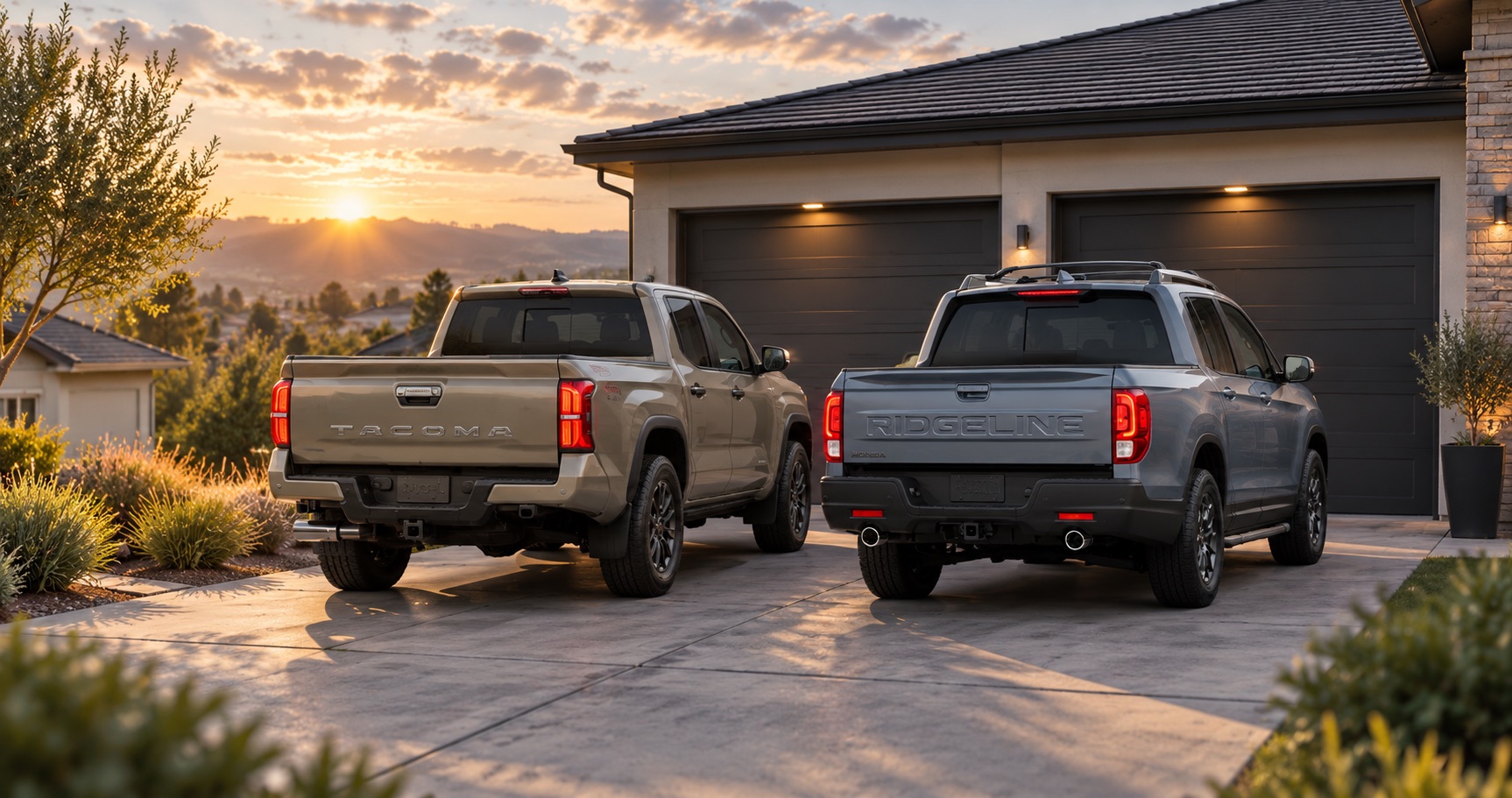
2026 Toyota Tacoma and Honda Ridgeline parked in a residential driveway in Tracy, CA

Where the Decision Lands

Choose the Truck Around the Capability You Will Actually Use

The cleanest dividing line is how often your routine reaches beyond the Ridgeline’s envelope. If you regularly need more than 5,000 pounds of towing, a 6-foot bed, low-range 4WD, a manual transmission, the i-FORCE MAX hybrid’s torque or specialized off-road hardware, Tacoma is the stronger tool—and it also carries a genuine price advantage in lower and comparable configurations.

If those needs are occasional or absent, the Ridgeline’s case becomes stronger because its differences show up during ordinary use: a calmer road ride, more rear-seat room, standard AWD, a wide flat bed floor and secure under-bed storage. That combination fits a truck that also spends substantial time commuting, carrying people and handling mixed household cargo.

For Tracy-area buyers, use your real calendar as the tie-breaker: I-205/I-580 weekday miles, school or work runs, hardware-store loads, Delta recreation and longer trips toward the foothills or Sierra. Tacoma makes more sense when the recurring trip demands its extra truck hardware. Ridgeline makes more sense when the truck has to be easy to live with during everything between those peak-demand days.

Decision Shortcuts

  • Mostly commuting, family use, errands & weekend projects: start with the Ridgeline.
  • More than 5,000 lbs of towing, a 6-ft bed, low-range 4WD or specialized trail use: start with the Tacoma.
  • Hybrid torque or a manual transmission is part of the brief: Tacoma is the only one of these two that offers it.
  • Secure hidden storage and easy bed access matter every week: Ridgeline’s In-Bed Trunk and dual-action tailgate are meaningful differentiators.

Frequently Asked Questions

2026 Honda Ridgeline vs Toyota Tacoma FAQ

Answers to the price, powertrain, cargo, winter-use and ownership questions that remain after the main comparison.

Is the 2026 Honda Ridgeline a real truck if it uses unibody construction?

Yes. The Ridgeline still provides an open pickup bed, an integrated Class III trailer hitch, a 5,000-pound maximum towing rating and a lineup payload maximum of 1,583 pounds. Unibody construction changes how the truck is engineered and how it behaves on the road; it does not change the fact that it is built to haul and tow within its published limits.

Does a 4WD Double Cab Tacoma still cost less than a Ridgeline?

Yes at the current published base-MSRP level. A 2026 Tacoma SR Double Cab with 4WD and the 5-foot bed is listed at $37,305 before Toyota delivery/processing and other charges, while the 2026 Ridgeline Sport starts at $40,795 before Honda destination. The gap is much smaller than the headline lineup-entry comparison, but Tacoma still holds the price advantage.

Does the 2026 Ridgeline or Tacoma offer a hybrid powertrain?

Tacoma does. Its available i-FORCE MAX hybrid is rated at 326 horsepower and 465 lb-ft of torque. The 2026 Ridgeline does not offer a hybrid; every trim uses a 280-hp 3.5-liter V6 with a 9-speed automatic and standard AWD.

Can the Ridgeline carry 4-by-8 sheet goods even though Tacoma offers a longer bed?

Yes. The Ridgeline bed measures 50 inches between the wheel wells, allowing 4-foot-wide sheet goods to lie flat across the bed floor, with the tailgate supporting longer material as needed. Tacoma counters with the option of a 6-foot bed, which is the more useful advantage when cargo length is the recurring constraint.

Which truck makes more sense for snow or mountain trips from Tracy?

For paved winter travel, the Ridgeline’s standard torque-vectoring AWD is the simpler always-on traction setup. Tacoma 4WD configurations add a two-speed transfer case with low range, and selected trims add locking-differential and trail-control hardware that is more useful on difficult unpaved routes. Tires, chain requirements, weather and route conditions still matter more than the badge alone.

Which includes more complimentary scheduled maintenance, Ridgeline or Tacoma?

ToyotaCare provides the longer included scheduled-maintenance window at 2 years or 25,000 miles, compared with Honda Service Pass at 1 year or 12,000 miles. Both trucks carry 3-year/36,000-mile basic and 5-year/60,000-mile powertrain warranties.

Where can I compare a 2026 Honda Ridgeline near Tracy, CA?

Tracy Honda is located at 3450 Auto Plaza Way in Tracy. You can review current Ridgeline inventory and trim information online, value a trade and then use an in-person drive to check seating, bed access, visibility and everyday road comfort before deciding whether the Ridgeline fits your routine.

Local Honda Support in the Greater Tracy Area

Why Tracy Honda Works Well for Long-Term Honda Ownership

Tracy Honda combines the accountability of a family-owned local Honda store with the resources of Harvey Automotive Group. The dealership has served the area for more than 15 years, while the family’s automotive roots trace back to 1954. For shoppers and owners, the practical benefit is a straightforward local ownership path: sales, financing, parts, customization and factory-authorized Honda service are connected through one team at 3450 Auto Plaza Way.

That connected structure can reduce how much has to happen during one dealership visit. Shoppers can review current inventory, start a trade-value or financing conversation online, then use the in-person visit for the things that still need a real vehicle in front of you. For customers balancing work and family schedules along the I-205 / I-580 corridor, that can make the shopping process easier to fit around the rest of the week.

Support continues after delivery through online service scheduling, a factory-authorized Honda service department, Honda Express Service for eligible routine maintenance, and Genuine Honda parts and accessory support. Keeping maintenance, repairs and future accessory needs connected to Honda-focused resources can save time and reduce guesswork over the years you own the vehicle.

Where to Go Next

Start Shopping or Keep Researching

Move directly into Ridgeline inventory, trade, financing and service support, or keep digging into trims, MPG and Honda ownership resources.

Disclaimers:
Vehicle specifications, pricing, EPA estimates, towing, payload and features were checked against current manufacturer information available September 8, 2026 and may change. MSRP excludes taxes, registration and dealer-specific pricing; destination, processing or distributor charges may apply. Towing and payload depend on exact configuration, equipment, passengers and cargo. Always verify the specific vehicle before purchase. Honda Sensing, Toyota Safety Sense and other driver-assist systems have operating limitations and do not replace attentive driving. Third-party opinions are their publishers’ own.