
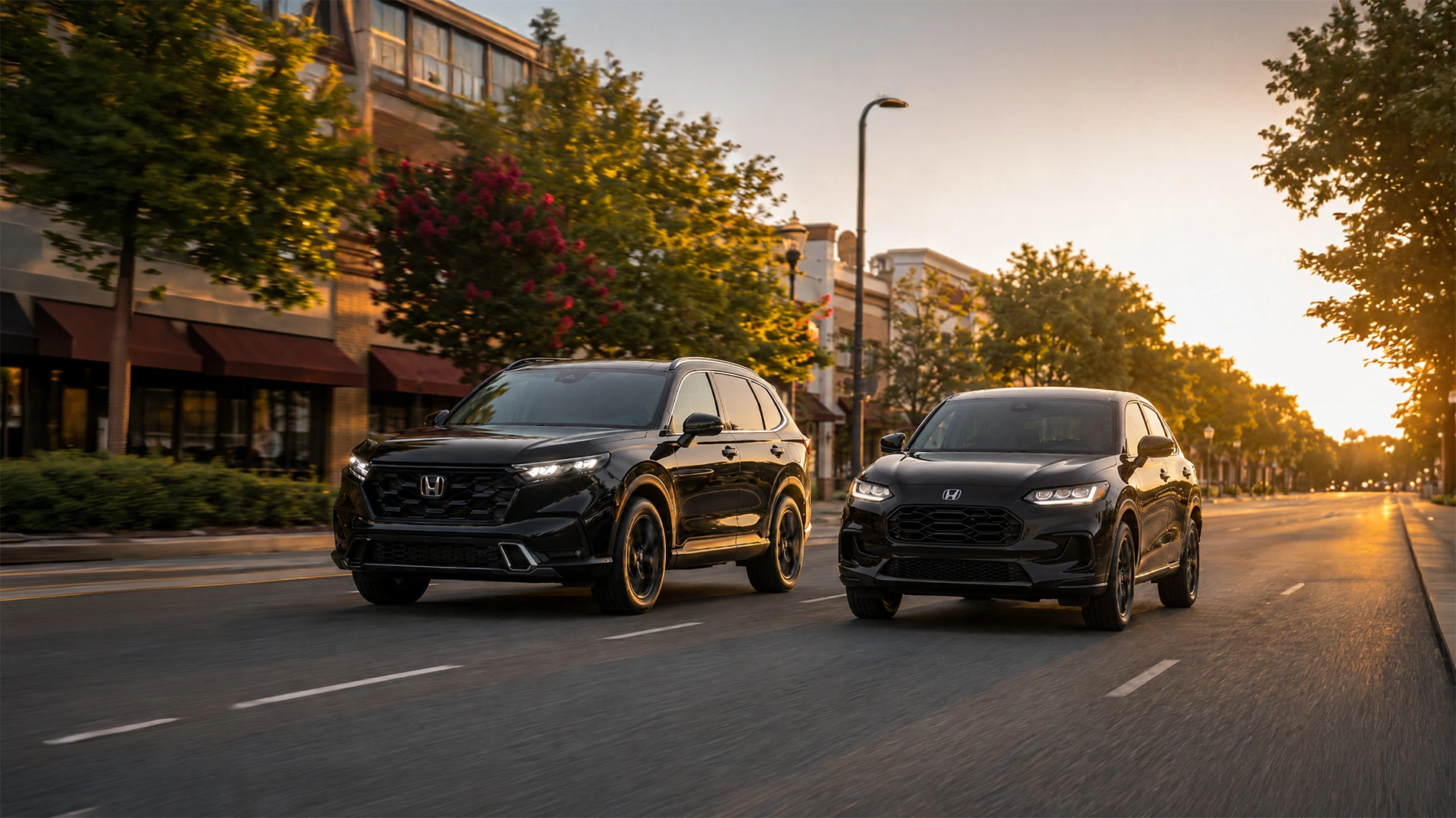
Honda CR-V vs Honda HR-V

Compare the 2026 Honda CR-V and 2027 Honda HR-V by price, size, cargo space, fuel economy, performance, technology, safety features, and real-world Honda SUV fit for drivers around the Bay Area and beyond.


The Honda CR-V vs Honda HR-V comparison is less about choosing a better Honda and more about choosing the right size, feature set, and daily-use fit. Both are practical two-row SUVs with modern technology, available AWD, and standard Honda Sensing® driver-assistive features. The difference is how much passenger room, cargo space, powertrain choice, and budget room you want from your next SUV.

The 2026 Honda CR-V is the roomier and more flexible choice. It offers more cargo space, more rear-seat room, more horsepower, available hybrid power, and a wider trim lineup. That makes it a strong fit for small families, growing households, hybrid shoppers, and drivers who want one SUV that can handle commuting, errands, regional trips, and weekend cargo without feeling undersized.

The 2027 Honda HR-V is the smaller and more manageable choice. It starts at a lower MSRP, keeps the trim walk easy to understand, and feels easier to park and maneuver. For commuters, first-time SUV shoppers, smaller households, and drivers who want useful Honda versatility without moving into a larger compact SUV, the HR-V has a clear role.

For Tracy-area shoppers, the question is practical: do you need the CR-V’s extra space and hybrid availability, or does the HR-V’s smaller footprint and lower starting price fit your routine better? This guide compares both models by trims, pricing, performance, MPG, dimensions, cargo space, technology, safety, and buyer fit.


Choose the 2026 Honda CR-V If...

You regularly carry passengers or cargo, want available hybrid efficiency, prefer stronger acceleration, or need a two-row SUV with more room to grow into over the next several years.

Choose the 2027 Honda HR-V If...

You want a lower starting price, easier parking, a simpler trim walk, available AWD, and enough SUV flexibility for commuting, errands, groceries, and smaller-household use.

Quick Answers Honda CR-V vs Honda HR-V

2026 Honda CR-V vs 2027 Honda HR-V: Fast Facts


What is the main difference between the Honda CR-V and Honda HR-V?
The CR-V is larger, roomier, more powerful, and available as a hybrid. The HR-V is smaller, less expensive, easier to maneuver, and simpler to compare.


Which Honda SUV costs less?
The 2027 Honda HR-V starts lower, with LX pricing beginning at $26,600 MSRP*. The 2026 Honda CR-V starts at $30,920 MSRP*.


Which one has a hybrid model?
The CR-V offers hybrid trims. The HR-V does not currently offer a hybrid powertrain.


Which has more cargo space?
The CR-V has more cargo room, with up to 76.5 cu-ft of maximum cargo volume. The HR-V offers up to 55.1 cu-ft.


Which is easier to park?
The HR-V is easier to park and maneuver because it is shorter, narrower, and lower than the CR-V.


Which is better for families?
The CR-V is usually the stronger family fit because it has more rear-seat room, more cargo space, and more powertrain flexibility. The HR-V works well for smaller households that do not need the CR-V’s extra space.

Quick takeaway: Choose the CR-V when space, hybrid efficiency, cargo room, and long-term flexibility matter most. Choose the HR-V when lower cost, easier parking, and smaller-SUV simplicity matter more.


Let’s Compare the Key Differences

between the 2026 Honda CR-V & 2027 Honda HR-V

The tables below organize the major differences first, then each section explains what those differences mean in daily ownership. That keeps the comparison focused on real decisions: space, price, efficiency, parking ease, passenger comfort, and long-term usefulness.

Core Differences Compact SUV Flexibility vs Smaller SUV Simplicity

Two Honda SUVs Built Around Different Needs

The 2026 Honda CR-V is the more versatile compact SUV. Its extra length, wider cargo area, available hybrid trims, and stronger powertrain options make it a better fit when the SUV has to support more than basic commuting. It feels more prepared for family use, weekend gear, longer regional drives, and shoppers who want space they can grow into.

The 2027 Honda HR-V is the more manageable SUV. It does not try to match the CR-V’s cargo volume or hybrid efficiency, and that is part of its clarity. It gives shoppers Honda SUV practicality in a smaller footprint, which can be the better fit for tighter parking, lighter cargo needs, lower monthly-payment goals, and drivers who want a simpler trim walk.

Category 2026 Honda CR-V 2027 Honda HR-V
Highlighted Differences Only — Not a Complete List of All Features, Specifications, or Options.
Vehicle Role • Larger two-row compact SUV
• Available hybrid trims
• More cargo room
• More family-friendly flexibility
• Smaller two-row SUV
• Lower starting price
• Simpler gas-only lineup
• Easier daily maneuverability
Best Real-World Fit Small families, hybrid shoppers, cargo-heavy routines, and drivers who want more long-term flexibility. Commuters, first SUV shoppers, smaller households, and drivers who want Honda utility without extra size.
Powertrain Personality Gas or hybrid choices, more horsepower, and stronger efficiency potential with hybrid trims. One straightforward gas engine across the lineup, making the shopping process simpler.
Space Personality More rear-seat room and cargo volume for growing routines, family travel, and larger weekend loads. Useful cargo space in a smaller package for groceries, work bags, gym gear, pets, and lighter trips.
Main Advantage More complete all-around SUV flexibility. Lower cost, smaller size, and easier day-to-day handling.

Core difference takeaway: The CR-V has the advantage when passenger room, cargo space, and powertrain choice matter most. The HR-V is the better fit when right-size ownership is more valuable than maximum space.

Trims & Pricing Lineup Structure, Starting MSRP & Buyer Fit

2026 Honda CR-V vs 2027 Honda HR-V Trims & Pricing

The HR-V lineup is short and easy to understand. LX, Sport, and EX-L give shoppers a clear progression from essential Honda SUV value to bolder styling and then added comfort. That simplicity is one of the HR-V’s strongest advantages for shoppers who do not want to sort through gas, hybrid, rugged-style, and premium-leaning configurations.

The CR-V lineup is broader because it covers more buyer needs. Gas trims keep the CR-V approachable, hybrid trims add stronger efficiency and response, TrailSport Hybrid adds standard AWD and a more rugged appearance, and Sport Touring Hybrid brings the lineup’s most premium technology and audio package. The CR-V asks shoppers to make more decisions, but it also gives them more ways to match the SUV to long-term use.

2026 Honda CR-V vs 2027 Honda HR-V Trims & Starting MSRP
MSRP Figures Shown Are Starting MSRP Only — Not Including Tax, Title, License, Registration, Destination, Accessories, Premium Paint, Dealer Fees, or Available Packages.
Model Trim Starting MSRP* Core Role
2026 Honda CR-V LX $30,920 Most approachable CR-V trim with the model’s larger cabin, cargo area, and core Honda technology.
EX $33,150 Adds daily comfort features such as moonroof, heated front seats, Smart Entry, and dual-zone automatic climate control.
Sport Hybrid $35,630 Entry point into CR-V hybrid power with sport-themed design details.
EX-L $35,400 Gas-powered CR-V with leather-trimmed seating and upgraded comfort.
TrailSport Hybrid $38,800 Hybrid CR-V with standard AWD, all-terrain tires, and more rugged visual character.
Sport-L Hybrid $38,725 Hybrid efficiency with leather-trimmed seating and added convenience.
Sport Touring Hybrid $42,550 Top CR-V Hybrid with standard AWD, Bose premium audio, hands-free power tailgate, and Google built-in.
2027 Honda HR-V LX $26,600 Most affordable Honda SUV path with strong standard technology and safety coverage.
Sport $28,400 Adds bolder styling, heated front seats, Smart Entry, and remote engine start.
EX-L $30,450 Most refined HR-V with leather-trimmed seats, moonroof, parking sensors, and dual-zone automatic climate control.

The price overlap matters. A well-equipped HR-V EX-L starts close to a CR-V LX, so the choice is not always as simple as small SUV versus big SUV. Some shoppers may prefer the HR-V EX-L because it gives them more comfort features in a smaller footprint. Others may choose the CR-V LX because cabin space, cargo room, and long-term flexibility matter more than the HR-V’s higher-trim features.

Trim & pricing takeaway: The HR-V starts lower and keeps shopping simpler. The CR-V costs more, but it gives shoppers more size, more powertrain choice, available hybrid efficiency, and a wider feature ceiling.

Performance, MPG & Towing Gas, Hybrid, AWD & Light Utility

2026 Honda CR-V vs 2027 Honda HR-V Performance & Efficiency

The CR-V has the stronger performance and efficiency story because it gives shoppers two distinct paths. Gas CR-V trims use a turbocharged engine with more horsepower and torque than the HR-V, while CR-V Hybrid trims add stronger system output and the best city MPG estimates in this comparison.

The HR-V takes a simpler approach. Every trim uses the same 2.0L 4-cylinder engine and CVT, so the driving experience stays consistent whether you choose LX, Sport, or EX-L. That does not make the HR-V the stronger performer, but it does make it easier to shop and easier to understand.

Honda CR-V vs Honda HR-V Performance, MPG & Towing
Figures Vary by Trim and Drivetrain. EPA Estimates Are for Comparison Purposes Only.
Category 2026 Honda CR-V 2027 Honda HR-V
Gas Engine 1.5L turbocharged 4-cylinder
190 hp / 179 lb-ft of torque
2.0L 4-cylinder
158 hp / 138 lb-ft of torque
Hybrid Availability Available two-motor hybrid powertrain
204 total system hp
Not available
Transmission • CVT on gas models
• E-CVT-style hybrid system on hybrid models
CVT
Drivetrain • FWD or available AWD on many trims
• AWD standard on TrailSport Hybrid and Sport Touring Hybrid
FWD or available Real Time AWD™
EPA MPG Range* • Gas models: up to 28 city / 33 highway
• Hybrid models: up to 43 city / 36 highway
Up to 26 city / 32 highway
Towing Capacity* • Gas models: up to 1,500 lbs when properly equipped
• Hybrid models: up to 1,000 lbs when properly equipped
Not Recommended to Tow With
Best Driving Fit Drivers who want more passing confidence, hybrid efficiency, and better support for loaded daily use. Drivers who want a simple, predictable, easygoing SUV for commuting and lighter everyday use.

In daily driving, the CR-V’s advantage shows up when the vehicle is carrying passengers, merging onto faster roads, or covering longer drives across the Central Valley, Livermore, or the wider I-205 / I-580 corridor. The hybrid trims are especially appealing for shoppers who spend time in stop-and-go traffic because their city MPG estimates are the strongest in the lineup.

The HR-V is better understood as easy transportation with SUV flexibility. It is not the model to choose if acceleration, towing, or hybrid efficiency are top priorities. It is the model to choose when the daily routine is mostly commuting, parking, errands, light cargo, and predictable driving.

Performance takeaway: The CR-V is the stronger and more efficient choice when hybrid power or extra response matters. The HR-V is the simpler fit when predictable daily driving matters more than powertrain variety.

Size, Dimensions & Maneuverability Parking Ease, Garage Fit & Road Presence

Honda CR-V vs HR-V Exterior Dimensions

The CR-V is larger in every major exterior measurement, and that size supports its roomier cabin and larger cargo area. It has more road presence and feels more substantial, which some drivers prefer on longer highway routes or when carrying passengers regularly.

The HR-V’s smaller footprint is one of its real advantages. It is shorter, narrower, and lower than the CR-V, which makes it easier to place in parking lots, apartment garages, downtown areas, and tight driveways. For many commuters, that day-to-day ease is more useful than extra cargo capacity they may rarely use.

Honda CR-V vs Honda HR-V Exterior Dimensions
Exterior Dimensions Help Explain Parking Ease, Garage Fit, Road Presence, and Cabin/Cargo Potential.
Measurement 2026 Honda CR-V 2027 Honda HR-V
Length 184.8 in 179.8 in
Width 73.5 in 72.4 in
Height 66.2 to 66.6 in 63.4 in
Wheelbase 106.3 to 106.7 in 104.5 in
Ground Clearance Up to 8.2 in Up to 7.3 in

The five-inch length difference does not sound dramatic on paper, but it can matter in daily use. The HR-V is easier to nose into tighter spaces, easier to work around in smaller garages, and less demanding in crowded lots. The CR-V gives up some of that parking ease, but it pays shoppers back with more passenger room and cargo flexibility.

Size takeaway: The CR-V uses its larger footprint to create more cabin and cargo flexibility. The HR-V uses its smaller footprint to make daily parking and maneuvering easier.

Interior Space & Cargo Room Passenger Comfort, Rear-Seat Room & Utility

Honda CR-V vs HR-V Interior Dimensions & Cargo Space

Both SUVs seat five, but the CR-V gives passengers and cargo more room to spread out. Its biggest real-world advantage is not just the maximum cargo number. It is the combination of rear-seat legroom, wider cargo usability, and extra volume behind the second row.

The HR-V remains useful because it keeps a flexible hatchback-style cargo area and folding rear seat inside a smaller SUV. It can handle groceries, school bags, work gear, small luggage, pet supplies, and everyday errands. The question is whether that level of space is enough for your routine.

Honda CR-V vs Honda HR-V Interior Dimensions & Cargo Space
Cargo and Passenger Figures Vary Slightly by Trim and Equipment.
Category 2026 Honda CR-V 2027 Honda HR-V
Rows / Seating Capacity 2 rows / 5 passengers 2 rows / 5 passengers
Passenger Volume Up to 106.0 cu-ft Up to 98.7 cu-ft
Front Headroom Up to 40.0 in Up to 39.4 in
Front Legroom 41.3 in 41.9 in
Rear Legroom 41.0 in 37.7 in
Cargo Volume Behind 2nd Row Up to 39.3 cu-ft 24.4 cu-ft
Maximum Cargo Volume Up to 76.5 cu-ft 55.1 cu-ft

The CR-V is the better choice when rear passengers are part of the weekly routine. The extra second-row legroom is useful for growing kids, adult passengers, car seats, and longer drives. The larger cargo area also makes a difference when the second row is occupied and there is still luggage, sports gear, or weekend equipment to carry.

The HR-V works best when the cargo load is lighter and the rear seat is not carrying passengers every day. It can still handle common SUV jobs, but it is not trying to be the same family-and-cargo vehicle as the CR-V. For shoppers who mostly drive solo, with one passenger, or with occasional rear-seat use, the smaller cabin may be exactly enough.

Interior space takeaway: The CR-V is the stronger fit for rear-seat passengers and larger cargo needs. The HR-V works best when smaller size and daily simplicity matter more than maximum room.

Amenities, Safety & Technology Comfort, Connectivity & Driver Assistance

Honda CR-V vs HR-V Amenities, Safety & Technology

The CR-V and HR-V both deliver the modern Honda basics shoppers expect, including a 9-inch touchscreen, wireless Apple CarPlay®, wireless Android Auto™, wireless phone charging, and Honda Sensing® driver-assistive features. That means the HR-V does not feel like a stripped-down alternative simply because it is smaller.

The CR-V has the higher feature ceiling. Its upper trims can add a larger digital instrument display, stronger audio options, Google built-in, power tailgate availability, hands-free access power tailgate availability, and more hybrid-focused technology. The HR-V keeps the feature walk shorter, with EX-L serving as the comfort-focused high point.

Honda CR-V vs Honda HR-V Amenities, Safety & Technology
Highlighted Features Only — Not a Complete List of All Equipment or Options. Availability Varies by Trim.
Feature Area 2026 Honda CR-V 2027 Honda HR-V
Touchscreen 9-inch color touchscreen 9-inch color touchscreen
Smartphone Integration Wireless Apple CarPlay® and Android Auto™ Wireless Apple CarPlay® and Android Auto™
Wireless Phone Charger Standard Standard
Digital Instrument Display • 7-inch display on LX / EX / Sport Hybrid
• 10.2-inch display on select higher trims
7-inch digital instrument cluster
Comfort Features • Available leather-trimmed seats
• Available heated steering wheel
• Available power tailgate
• Available hands-free access power tailgate
• Available heated front seats
• Available leather-trimmed seats
• Available moonroof
• Available front and rear parking sensors
Honda Sensing® Standard driver-assistive safety suite with features including Collision Mitigation Braking System™, Road Departure Mitigation, Adaptive Cruise Control, Lane Keeping Assist, and Traffic Sign Recognition. Standard driver-assistive safety suite with similar core Honda Sensing® support across the lineup.
Blind Spot Information Standard on EX and above Standard on Sport and EX-L
Parking / Low-Speed Support Available on select trims Standard on EX-L

For many shoppers, safety technology will not be the deciding factor between these two SUVs because both models include a strong Honda Sensing foundation. The difference is more about trim availability and the type of vehicle around those systems. The CR-V gives families more space and a higher technology ceiling. The HR-V gives smaller-SUV shoppers a surprisingly complete standard tech package.

Technology & safety takeaway: The HR-V covers the features many shoppers use every day, including wireless smartphone integration, wireless charging, and standard Honda Sensing®. The CR-V adds more upgrade room through its higher trims, especially for audio, displays, cargo access, hybrid information, and premium convenience features.

Buyer Fit Which Honda SUV Should You Choose?

Should You Choose the Honda CR-V or Honda HR-V?

The best way to choose between the CR-V and HR-V is to start with the space question. If the SUV will regularly carry rear passengers, sports gear, luggage, pets, or road-trip cargo, the CR-V gives you more margin before the vehicle starts to feel full.

If the SUV’s main job is commuting, errands, light cargo, and easier parking, the HR-V may be the smarter fit. It keeps Honda practicality in a smaller and more affordable package, which can be more useful than buying extra room you rarely use.

Choose Based on Your Priority 2026 Honda CR-V 2027 Honda HR-V
Buyer-Fit Guidance Only — Final Choice Should Be Based on Your Driving Needs, Passenger Needs, Budget, Preferred Features, and Available Inventory.
Best Reason to Choose It More space, available hybrid power, stronger output, larger cargo area, and more long-term flexibility. Lower starting price, smaller footprint, easier parking, simpler lineup, and practical Honda SUV utility.
Daily Commute Best when the commute includes passengers, highway merging, longer drives, or hybrid-efficiency priorities. Best when the commute is mostly solo or light-duty and easy parking matters.
Family Use Stronger fit for small families, car seats, rear passengers, road trips, and growing household needs. Works well for smaller households that do not need the CR-V’s extra rear-seat and cargo room.
Cargo Use Better for bulky gear, luggage, strollers, home-improvement runs, and larger weekly errands. Better for groceries, gym bags, work gear, small luggage, and lighter everyday cargo.
Budget Sensitivity Worth considering when the extra room, hybrid availability, or feature ceiling will be used often. Strong choice when lower starting price and right-size ownership are high priorities.
Good Starting Point Start with CR-V LX or EX for gas value, or Sport Hybrid if hybrid efficiency is a priority. Start with HR-V LX for value, Sport for style and heated seats, or EX-L for the most comfort.

The CR-V is the right answer when the extra space will be used often enough to matter. It is not just larger for the sake of being larger; it gives shoppers more rear-seat comfort, more cargo flexibility, available hybrid efficiency, and more equipment range.

The HR-V is the right answer when smaller size is a benefit instead of a compromise. It keeps the SUV easy to park, easier to afford, and easier to understand, while still giving drivers available AWD, modern tech, and everyday cargo versatility.

Buyer-fit takeaway: Choose the CR-V for space, hybrid availability, powertrain flexibility, and family-ready cargo room. Choose the HR-V for lower cost, smaller size, simple shopping, and easier day-to-day maneuverability.

What Third-Party Reviewers Tend to Say

Third-party reviews are useful here because they tend to confirm the same buyer split found in the specs. The CR-V is often discussed as the more complete compact SUV, while the HR-V is better understood as a smaller, easiergoing Honda SUV with a simpler ownership profile.

Honda CR-V

Reviewer theme:
Practical compact SUV with strong space, cargo usability, available hybrid efficiency, and broad daily-use appeal.


Fair critique:
Higher trims can move up in price, and towing remains light-duty compared with larger SUVs or trucks.

Read the Car and Driver Honda CR-V Review

Honda HR-V

Reviewer theme:
Approachable small SUV with a clean cabin layout, manageable size, useful cargo shape, and easy daily-driving character.


Fair critique:
Acceleration is modest, there is no hybrid option, and the CR-V offers more rear-seat and cargo room.

Read the Car and Driver Honda HR-V Review

*Third-party review summaries are included for shopper context only. Review opinions, scores, rankings, and article content may change over time.

Ready to compare them in person?

Compare the Honda CR-V & HR-V at Tracy Honda

The best way to choose between the CR-V and HR-V is to sit in both, compare rear-seat space, check the cargo floor, review hybrid availability, and see how each SUV feels from the driver’s seat. Tracy Honda can help you compare trims, FWD and AWD options, current inventory, trade-in value, and payment fit.


Final Thoughts: Honda CR-V vs Honda HR-V

The 2026 Honda CR-V and 2027 Honda HR-V overlap in the areas that matter most to Honda shoppers: practical two-row layouts, available AWD, useful technology, standard Honda Sensing® features, and everyday dependability. The decision comes down to whether your routine is better served by more space and powertrain choice or by a smaller, simpler SUV.

The CR-V is the better match when the SUV has to support several roles. Its larger cabin, stronger cargo area, available hybrid trims, higher horsepower, and broader trim range make it easier to grow into over time.

The HR-V is the cleaner choice when smaller size is part of the appeal. It is easier to park, starts lower in price, keeps the trim walk simple, and still gives drivers a useful Honda SUV shape for commuting, errands, and lighter cargo needs.

Final takeaway: Choose the CR-V for room, hybrid availability, cargo flexibility, and long-term versatility. Choose the HR-V for easier parking, lower starting cost, simple ownership, and right-size Honda SUV practicality.


FAQ: Honda CR-V vs Honda HR-V


What is the main difference between the Honda CR-V and Honda HR-V?

The main difference is size and flexibility. The Honda CR-V is larger, roomier, more powerful, and available with hybrid power. The Honda HR-V is smaller, less expensive, easier to park, and simpler to compare.

Is the Honda CR-V bigger than the Honda HR-V?

Yes. The Honda CR-V is longer, wider, taller, roomier, and offers more cargo volume than the Honda HR-V.

Which costs less, the Honda CR-V or Honda HR-V?

The Honda HR-V costs less to start. The 2027 Honda HR-V LX starts at $26,600 MSRP*, while the 2026 Honda CR-V LX starts at $30,920 MSRP*.

Does the Honda HR-V have a hybrid model?

No. The 2027 Honda HR-V uses a gas 2.0L 4-cylinder engine across the lineup. Shoppers who want a Honda hybrid SUV should compare CR-V Hybrid trims.

Which has better MPG, the CR-V or HR-V?

The CR-V Hybrid offers the strongest fuel economy in this comparison, with up to 43 city / 36 highway MPG*. Gas CR-V and HR-V estimates vary by trim and drivetrain.

Which has more cargo space, the Honda CR-V or Honda HR-V?

The Honda CR-V has more cargo space. It offers up to 76.5 cu-ft of maximum cargo volume, while the Honda HR-V offers up to 55.1 cu-ft.

Does the Honda HR-V have enough room for a family?

The HR-V can work well for smaller families, lighter cargo needs, and drivers who do not regularly carry bulky gear. The CR-V is the stronger family fit when rear-seat space, cargo room, and road-trip flexibility matter more.

Do both the CR-V and HR-V offer AWD?

Yes. Both the Honda CR-V and Honda HR-V offer available AWD, though availability varies by trim. Some CR-V Hybrid trims include standard AWD.

Is the CR-V worth the extra cost over the HR-V?

The CR-V is easier to justify if you will use the extra cargo room, rear-seat space, available hybrid power, stronger performance, or higher feature ceiling. The HR-V may be the better value if you want a smaller Honda SUV and do not need the CR-V’s added space.

Which Honda SUV should I test drive first?

Test drive the CR-V first if you are unsure whether you need more rear-seat and cargo space. Test drive the HR-V first if you already know parking ease, lower starting cost, and smaller-SUV maneuverability are your top priorities.


Compare the Honda CR-V & HR-V at Tracy Honda

Tracy Honda can help shoppers compare the 2026 Honda CR-V and 2027 Honda HR-V beyond the spec sheet. Sitting in both SUVs, checking rear-seat space, opening the cargo area, comparing visibility, and reviewing trim equipment can make the decision clearer than numbers alone.

Whether you are commuting around Tracy, traveling toward Manteca or Mountain House, connecting to I-205 and I-580, or looking for a practical SUV for family errands and weekend plans, Tracy Honda can help you compare current CR-V and HR-V inventory with model-specific guidance.


DISCLAIMERS:
*MSRP excludes tax, title, license, registration, destination charge, accessories, premium paint charges, dealer-installed options, and dealer fees. Actual dealer price may vary. See Tracy Honda for current pricing and availability.
*EPA mileage ratings are estimates for comparison purposes only. Your actual mileage will vary depending on driving conditions, driving habits, vehicle condition, fuel, trim, drivetrain, cargo, accessories, battery age, and other factors.
*Towing capacity shown is the maximum rating when properly equipped. Actual towing capacity depends on vehicle configuration, passengers, cargo, accessories, trailer weight, hitch equipment, and other factors. Always consult the owner’s manual and follow Honda towing guidelines.
*Cargo volume, passenger volume, dimensions, seating capacity, ground clearance, and feature availability may vary by trim level, configuration, measurement method, and equipment. Specifications are based on information available from Honda at the time of writing and are subject to change.
*Honda Sensing® and other driver-assistive technologies are not substitutes for attentive driving. System operation can be affected by weather, road conditions, vehicle condition, visibility, traffic, and other factors. The driver remains responsible for safely operating the vehicle.
*Hybrid, AWD, drive-mode, towing, cargo, and technology descriptions are intended for general comparison purposes. Feature availability and capability depend on trim, configuration, accessories, conditions, and safe operation.
*Third-party review references are summarized for shopper context only. Ratings, awards, opinions, and article content may change over time and should be reviewed directly through the cited publisher.