Honda Lineup Flexibility, Toyota Efficiency & the Right Everyday Fit
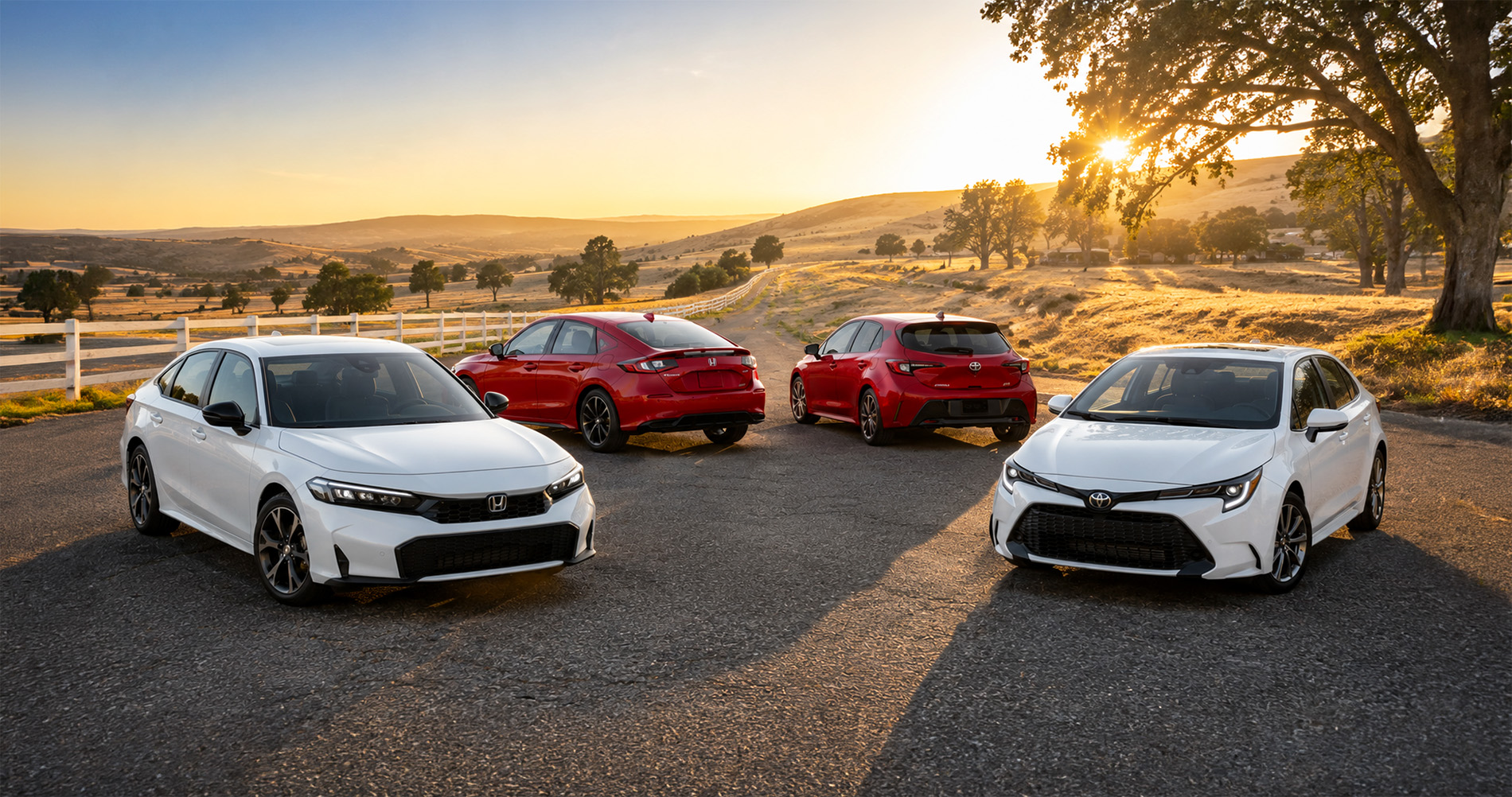
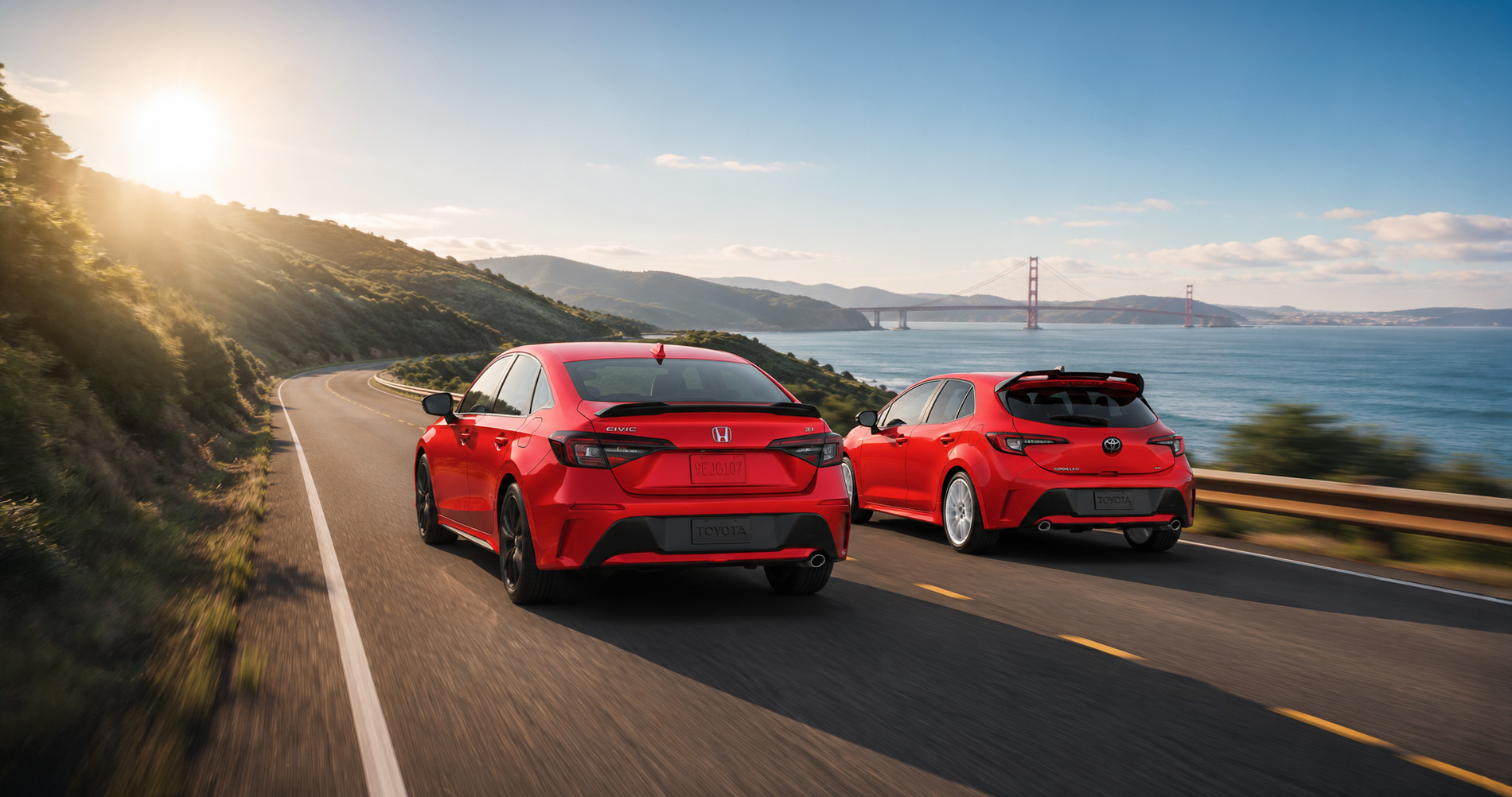
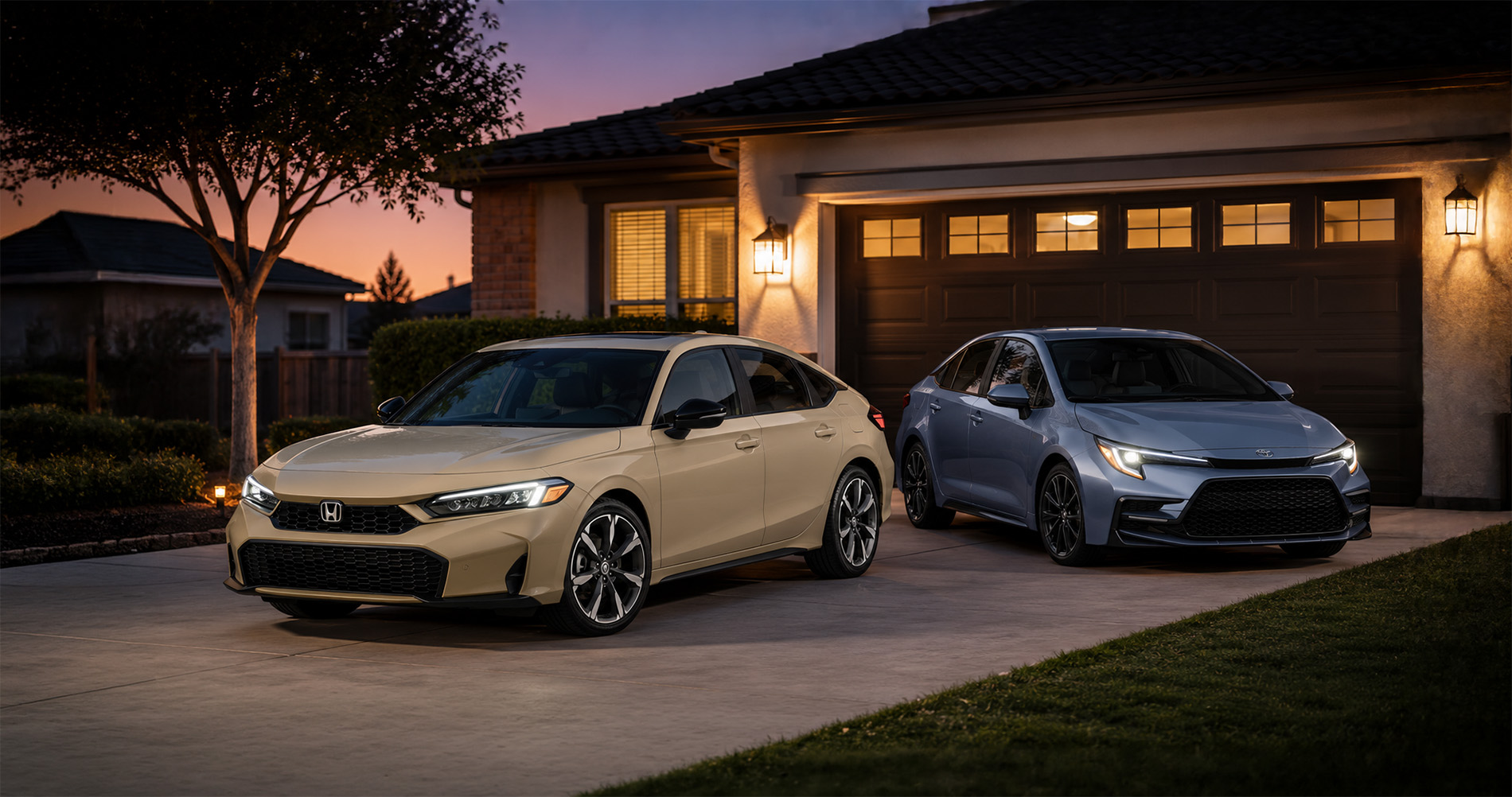
The 2026 Honda Civic and 2026 Toyota Corolla comparison extends well beyond two compact sedans. Honda offers gas and hybrid Civic Sedans, gas and hybrid Civic Hatchbacks, and the manual-transmission Civic Si. Toyota answers with gas and hybrid Corolla Sedans plus the gas-powered Corolla Hatchback. Shoppers therefore need to compare not only price and fuel economy, but also body style, drivetrain, passenger use, cargo access, technology, and driving character.
The two families approach those needs differently. Corolla emphasizes accessible pricing, efficient daily transportation, available hybrid AWD, and useful standard equipment. Civic provides a wider range of personalities, including a more powerful hybrid offered in two body styles, a roomier and more flexible cabin, premium upper-trim technology, and a dedicated performance sedan. Neither formula is automatically better; each serves a different set of priorities.
This guide compares the complete Civic and Corolla families, then translates the important differences into everyday ownership decisions. For Tracy-area drivers balancing I-205 and I-580 commuting with local errands, passenger needs, and weekend travel, the goal is to identify the configuration that requires the fewest compromises rather than declare one universal winner.
Quick AnswersThe essential 2026 Honda Civic vs Toyota Corolla differences▼
What is the main Civic vs Corolla difference? Corolla is the more value- and efficiency-focused family, with a lower entry price, a stronger gas-engine specification, available hybrid AWD, and longer included scheduled maintenance. Civic provides more distinct ownership paths through gas and hybrid sedans, gas and hybrid hatchbacks, premium hybrid trims, and Civic Si.
Which compact car is better for commuting? Corolla Hybrid is the stronger place to start when the highest published MPG, available AWD, or the lowest hybrid entry price leads the decision. Civic Hybrid is the stronger place to start when responsive freeway acceleration, a choice between sedan and hatchback, or a more polished cabin and road experience matters more.
Which has the better hybrid? Civic Hybrid produces 200 total system horsepower and is available as a sedan or hatchback. Corolla Hybrid produces 138 net combined horsepower, reaches up to an estimated 50 combined MPG, and offers Electronic On-Demand AWD on eligible LE and SE configurations.
Which has more cargo flexibility? Civic has the stronger overall cargo case. The Sedan lists 14.8 cubic feet of trunk space, while the Hatchback lists 24.5 cubic feet behind the rear seat and can be ordered with gas or hybrid power. Corolla Hatchback is shorter and easier to park, but its standard cargo figure is smaller and it does not offer a hybrid.
Is the Civic worth paying more for? The price difference is easiest to justify when stronger hybrid response, more rear-seat or cargo room, a hybrid hatchback, premium upper-trim technology, or Civic Si hardware will affect the normal week. Corolla remains the stronger value when those advantages are less important than price, MPG, AWD, and early maintenance coverage.
Core Differences: 2026 Honda Civic vs 2026 Toyota Corolla
Start with the family-level split before comparing every trim and specification. Corolla concentrates on approachable pricing, efficient transportation, available hybrid AWD, and straightforward ownership support. Civic covers more distinct roles: value-focused gas commuting, a more powerful hybrid in two body styles, premium upper trims, and a dedicated sport sedan.
2026 Honda Civic vs 2026 Toyota Corolla at a GlanceShopper-level differences only. Detailed figures, trim notes, and ownership meaning appear in the comparison slider below.
Category
2026 Honda Civic Family
2026 Toyota Corolla Family
Core Identity
Gas and hybrid Sedans, gas and hybrid Hatchbacks, and Civic Si create several distinct ownership paths.
Gas and hybrid Sedans plus a gas Hatchback emphasize value, efficiency, and simple daily use.
Starting Price Direction*
Civic Sedan LX: $24,695 before destination. Honda starts higher but expands into more specialized configurations.
Corolla Sedan LE: $23,125 before Dealer Processing and Handling. Toyota provides the lower-cost entry path.
Gas Power
150 hp / 133 lb-ft 2.0-liter four-cylinder with CVT.
169 hp / 151 lb-ft 2.0-liter Dynamic Force four-cylinder with Dynamic-Shift CVT.
Hybrid Direction
200 total system hp Up to 49 combined MPG* FWD Sedan or Hatchback
138 net combined hp Up to 50 combined MPG* FWD or available AWD Sedan only
Passenger & Cargo Use
37.4 in. rear legroom 14.8-cu-ft Sedan trunk 24.5 cu ft behind the Hatchback rear seat
34.8 in. rear legroom 13.1-cu-ft Sedan trunk 17.8 cu ft in the standard Hatchback cargo layout
Technology & Safety
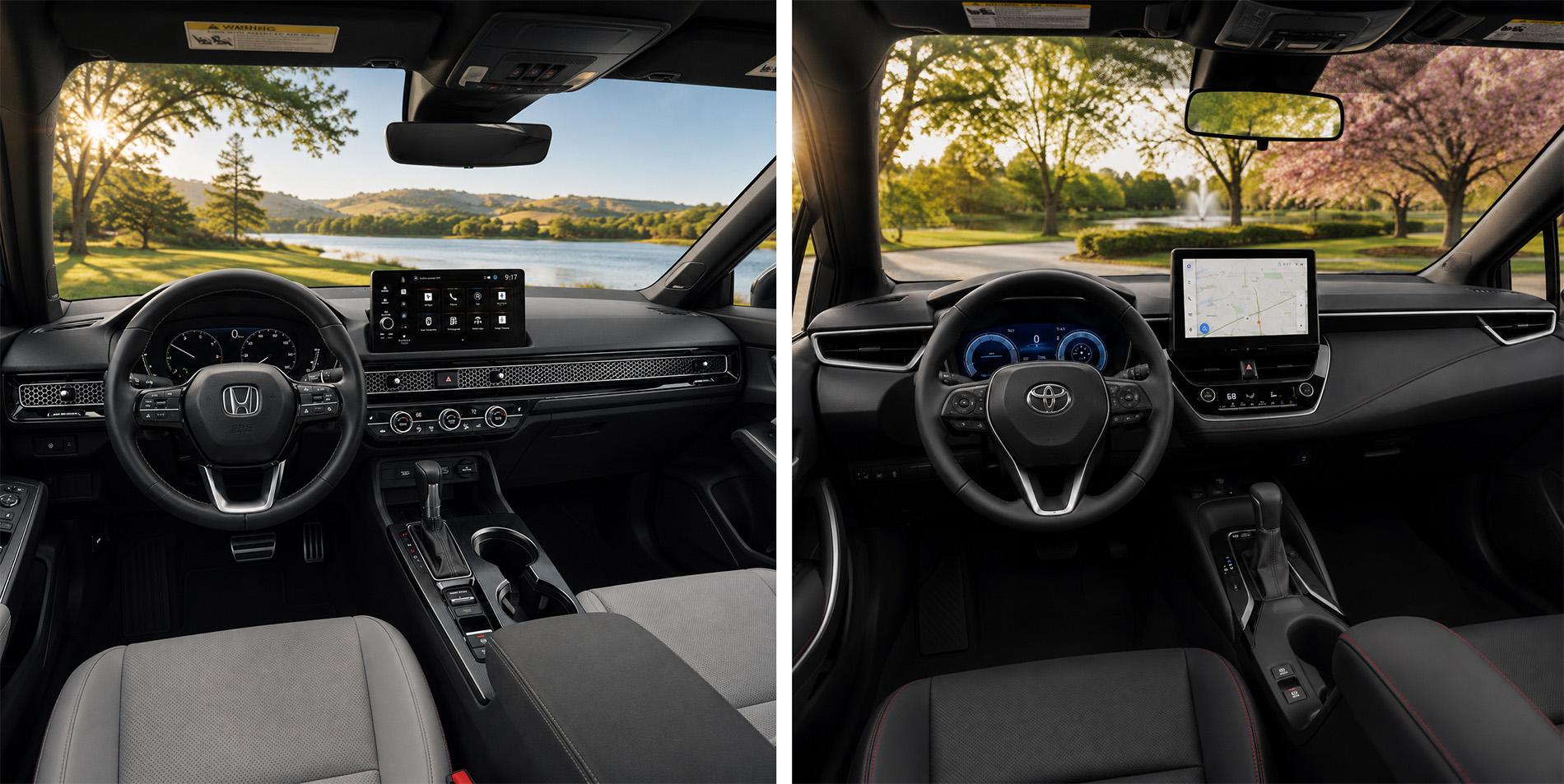
Upper trims add Google built-in, Bose audio, and a 10.2-inch cluster. Blind Spot Information begins above Sedan LX.
Larger maximum displays, standard wireless phone integration, and standard Blind Spot Monitor with Rear Cross-Traffic Alert across the family.
Ownership Direction
Honda Service Pass covers eligible scheduled maintenance for 1 year/12,000 miles. High-voltage battery coverage is 8 years/100,000 miles nationally and 10 years/150,000 miles in California.
ToyotaCare covers eligible maintenance for 2 years/25,000 miles. The hybrid battery is covered for 10 years/150,000 miles; other hybrid-related components are generally covered for 8 years/100,000 miles.
What These Differences Mean
Corolla’s advantages are clearest when price, fuel economy, available hybrid AWD, and early maintenance coverage carry the most weight. Its gas engine also produces more power than the standard Civic engine, and Toyota includes blind-spot monitoring and rear cross-traffic alert throughout the 2026 family. Those are meaningful strengths for a shopper who wants a well-equipped commuter without paying for capability that will not be used.
Civic creates more separation as the decision moves beyond the least expensive versions. The 200-horsepower hybrid provides a stronger response for freeway merging and grades, Honda lets buyers combine hybrid power with either body style, and the Hatchback provides more measured cargo room. Sport Touring Hybrid adds a more integrated premium-technology experience, while Civic Si gives enthusiast shoppers a configuration the conventional Corolla range does not match.
The practical question is whether Corolla’s lower-cost, efficiency-led formula solves the entire need or whether Civic’s additional powertrain, body-style, cabin, and performance choices will matter often enough to justify the higher price.
Third-Party Review Lens
What Reviewers Notice Beyond the Specifications
Current Car and Driver evaluations add context for qualities such as steering, refinement, cabin usability, and overall execution that a specification sheet cannot fully capture.
Car and Driver
2026 Honda Civic
10/10 RatingRanked #1 Compact Car
Editors’ Choice2026 10Best
Car and Driver highlights the Civic family’s clean design, roomy cabin, efficient powertrains, quick hybrid performance, balanced ride, agile handling, and ability to serve mainstream and enthusiast drivers.
Car and Driver credits the Corolla for high fuel economy, broad standard driver-assistance technology, sedan and hatchback availability, a comfortable ride, and an easy-to-park profile.
The balanced takeaway The Civic has the stronger current reviewer-accolade story because it combines efficiency, space, refinement, handling, and lineup breadth more successfully. Corolla’s slightly lower entry price, available hybrid AWD, and ToyotaCare remain legitimate reasons to consider it — but many models in the segment outrank it overall.
Compare the 2026 Civic & Corolla by What Matters Most
Choose a topic to compare the full Civic and Corolla families without repeating the same recommendation in every section.
Select a Topic or Swipe to See More
Comparison Topic 1 of 8
Powertrains, Hybrid Systems & MPG
Gas output, hybrid performance, drivetrain choice, efficiency, and price direction
Powertrain and Efficiency ComparisonMPG figures are EPA or manufacturer estimates. Starting MSRPs exclude delivery, processing, taxes, registration, options, and dealer charges.
Category
2026 Honda Civic
2026 Toyota Corolla
Gas Engine
2.0-liter four-cylinder 150 hp / 133 lb-ft CVT Efficient and smooth, but not the stronger base-engine specification.
2.0-liter Dynamic Force four-cylinder 169 hp / 151 lb-ft Dynamic-Shift CVT More conventional gas-engine output.
Hybrid System
200 total system hp Sedan or Hatchback FWD
138 net combined hp Sedan only FWD or available Electronic On-Demand AWD
Hybrid FWD: up to 53/46/50 MPG AWD reduces efficiency and varies by trim.
Starting MSRP*
Civic LX: $24,695 Sport Hybrid Sedan: $29,395
Corolla LE: $23,125 Hybrid LE: $24,575
Powertrain Meaning
Civic offers the broader range of personalities, from efficient gas commuting to a quick hybrid and a separate manual-performance model.
Corolla offers the stronger base gas output, the lower-cost hybrid path, and the only AWD choice.
What the Powertrain Differences Mean
The Corolla’s powertrain advantages are easiest to justify when the purchase centers on upfront cost, conventional gas-engine output, maximum hybrid efficiency, or available AWD. Civic Hybrid is not simply an efficiency upgrade over the gas Civic; it changes how the car responds during merging, passing, and grades while preserving the choice between Sedan and Hatchback. Shoppers should therefore compare the hybrids based on driving behavior and body-style needs, not MPG alone.
Comparison Topic 2 of 8
Performance, Ride & Handling
Acceleration, Civic Si hardware, suspension design, footprint, and road manners
Performance and Chassis ComparisonIndependent test results vary with trim, tires, surface, weather, loading, fuel, procedure, and driver inputs.
Category
2026 Honda Civic
2026 Toyota Corolla
Strongest Automatic Choice
Civic Hybrid 200 total system hp Car and Driver recorded 6.1 seconds to 60 mph for a Sport Hybrid Hatchback and 6.2 seconds for a Hybrid Sedan.
169-hp gas engine Car and Driver recorded 8.2 seconds for a Corolla Hatchback FX and 9.0 seconds for a tested Corolla Hybrid AWD.
Manual Performance
Civic Si 200-hp turbo engine Six-speed manual Rev-match control Helical limited-slip differential
No direct conventional-lineup equivalent Gas and hybrid Corolla models use automatic transmissions.
Rear Suspension
Multi-link throughout Gas, hybrid, Hatchback, and Si models.
Configuration-dependent Gas Sedan LE uses a torsion beam; other Sedan grades and all Hatchbacks use multi-link.
Exterior Footprint
Sedan: 184.8 in. Hatchback: 179.0 in. More cabin and cargo room within a larger footprint.
Sedan: 182.3 in. Hatchback: 172.0 in. Shorter dimensions can simplify parking.
Road-Manner Direction
More consistent emphasis on steering response, body control, and driver involvement.
Comfortable, predictable, and easy to place, with less emphasis on feedback and acceleration.
What the Driving Differences Mean
Civic’s advantage becomes meaningful for drivers who notice steering response, body control, passing performance, or the added involvement of a manual transmission. Corolla’s advantage is lower-effort operation within a smaller exterior footprint, especially in Hatchback form. A useful test drive should include a freeway merge, uneven pavement, a sweeping turn, and a tight parking maneuver because those situations reveal more than acceleration figures alone.
Comparison Topic 3 of 8
Interior Space, Materials & Comfort
Rear-seat usefulness, cabin design, upper-trim equipment, and long-commute comfort
Cabin Space and Comfort ComparisonInterior measurements and equipment vary by body style, trim, moonroof, seating equipment, and manufacturer measurement method.
Category
2026 Honda Civic
2026 Toyota Corolla
Rear Legroom
37.4 inches Listed for both Sedan and Hatchback.
34.8 inches in the Sedan 29.9 inches in the Hatchback
Streamlined dashboard and familiar controls that keep common tasks straightforward.
Upper-Trim Seating
Sport Touring Hybrid: leather-trimmed seats, heated front seats, power-adjustable front seats, and moonroof.
XSE and Hybrid XLE: SofTex-trimmed seating, heated front seats, and power-adjustable driver’s seat.
Passenger Role
Better suited to regular adult rear passengers, child-seat access, and longer trips with both rows occupied.
Corolla Sedan remains practical. Corolla Hatchback is more front-seat-focused and better for occasional rear-passenger duty.
Refinement Direction
Reviewers consistently credit the clean layout, useful storage, composed ride, and smooth hybrid operation.
The cabin is approachable and comfortable, though hard acceleration exposes more powertrain noise and less refinement.
What the Interior Differences Mean
The Civic’s space advantage matters most when adults, teenagers, or child seats regularly occupy the second row. Corolla Sedan remains suitable for normal compact-car passenger use, while Corolla Hatchback makes a clearer trade between rear-seat room and exterior size. Before choosing, place the front seat in the normal driving position, sit behind it, check door-opening access, and operate the climate and infotainment controls without assistance.
Comparison Topic 4 of 8
Cargo Space & Body-Style Flexibility
Sedan trunks, hatchback loading, hybrid utility, and exterior-size tradeoffs
Cargo and Hatchback-Use ComparisonCargo measurements can differ by manufacturer method, trim, cargo-floor position, spare-tire provision, audio equipment, and rear-seat position.
Category
2026 Honda Civic
2026 Toyota Corolla
Sedan Trunk
14.8 cubic feet Listed across gas and hybrid Civic Sedan grades.
13.1 cubic feet A practical compact-sedan trunk with less published volume.
Hatchback Cargo
24.5 cubic feet behind the rear seat Wide rear opening and a gas-or-hybrid choice.
17.8 cubic feet standard An enhanced-cargo layout can approach 23 cubic feet by replacing the spare tire with a repair kit.
Hybrid Hatchback
Available Sport Hybrid and Sport Touring Hybrid.
Not offered Every Corolla Hatchback uses the 169-hp gas engine.
Rear-Seat Folding
60/40 split-folding Longer cargo can share the cabin with a rear passenger.
60/40 split-folding Cargo-floor and spare-tire choices affect the layout.
Footprint Tradeoff
More measured cargo and rear-seat room within a 179.0-inch Hatchback body.
Less standard cargo room but easier parking within a 172.0-inch Hatchback body.
What the Cargo Differences Mean
Civic is the more versatile family when bulky or changing cargo is part of the normal routine, particularly because its larger Hatchback can be paired with gas or hybrid power. Corolla Hatchback makes more sense when garage length and parking ease outweigh maximum capacity. Shoppers considering Toyota’s enhanced-cargo arrangement should also decide whether the additional space is worth replacing the spare tire with a repair kit.
Comparison Topic 5 of 8
Technology & Safety
Display sizes, native services, phone integration, audio, blind-spot coverage, and parking support
Technology and Driver-Assistance ComparisonConnected services can require compatible devices, accounts, cellular data, trials, or paid subscriptions. Driver-assistance systems have operational limits.
Category
2026 Honda Civic
2026 Toyota Corolla
Standard Touchscreen
7 inches Lower grades use wired Apple CarPlay and Android Auto.
8 inches Wireless Apple CarPlay and Android Auto are standard.
Largest Displays
9-inch touchscreen 10.2-inch digital cluster
10.5-inch touchscreen 12.3-inch digital gauge cluster
Native Integration
Google built-in on eligible grades with Google Maps, Google Assistant, and supported apps.
Toyota Audio Multimedia with available Drive Connect, cloud navigation, and voice assistance.
Premium Audio
12-speaker Bose Standard on Sport Touring Hybrid and Civic Si.
Available JBL system Availability varies by Sedan and Hatchback grade.
Blind-Spot Coverage
Trim-dependent Sedan LX does not include Blind Spot Information. Sport and higher Sedan grades, all Hatchbacks, and Si include it.
Standard throughout the family Blind Spot Monitor and Rear Cross-Traffic Alert are included across Sedan, Hybrid, and Hatchback grades.
Parking Support
Sport Touring Hybrid: front and rear parking sensors plus Low-Speed Braking Control.
Parking and low-speed assistance vary by grade and package.
What the Technology & Safety Differences Mean
Toyota delivers more technology and blind-spot coverage at the lower end of the lineup, making Corolla especially competitive for shoppers who plan to stay near the base price. Honda’s advantage appears farther up the range, where its displays, Google built-in services, Bose audio, wireless features, and parking support are packaged together. Compare the trims you would actually buy rather than judging either family by its largest available screen.
Comparison Topic 6 of 8
Trim Choices & Value Strategy
How each family separates price, equipment, body style, drivetrain, and performance
Full Lineup MapTrim availability, special editions, colors, packages, accessories, and inventory can change. Confirm current production and dealer availability.
Lineup
2026 Honda Civic
2026 Toyota Corolla
Gas Sedan
LX and Sport A simple value-to-sport progression.
LE, SE, and XSE Three gas grades, including a premium gas-only XSE.
Hybrid Sedan
Sport Hybrid and Sport Touring Hybrid Both use the 200-hp system.
Hybrid LE, LE AWD, SE, SE AWD, and XLE More drivetrain and grade combinations.
Gas Hatchback
Sport One gas grade keeps the choice straightforward.
SE, FX, and XSE More equipment and appearance choices.
Hybrid Hatchback
Sport Hybrid and Sport Touring Hybrid
Not offered
Performance Grade
Civic Si Manual transmission and dedicated chassis hardware.
No equivalent in this scope
Value Direction
Broader by vehicle mission: gas, hybrid, premium hybrid, cargo-focused Hatchback, and enthusiast Si.
Broader within conventional categories: more gas grades, more gas Hatchback grades, and FWD/AWD hybrid combinations.
What the Trim Strategies Mean
Toyota gives shoppers more incremental steps within its gas Sedan, gas Hatchback, and hybrid ranges. Honda uses fewer intermediate steps but creates more clearly separated vehicle missions, including a hybrid Hatchback and Civic Si. The best value is usually the first trim that includes every must-have feature, not the least expensive trim or the version with the longest equipment list.
Comparison Topic 7 of 8
Reliability & Long-Term Confidence
Historical repair data, what current ratings can establish, and what remains unknown about new 2026 vehicles
Civic and Corolla Reliability ContextRepairPal ratings summarize historical model-level repair data covering 2010–2019 vehicles. They are useful for nameplate context but are not 2026 model-year predictions. New vehicles have not accumulated enough time or mileage for definitive long-term reliability conclusions.
Category
Honda Civic
Toyota Corolla
Historical RepairPal Rating*
4.5 out of 5.0 Ranked third among 36 compact cars. A history of reliability
4.5 out of 5.0 Ranked first among 36 compact cars. A history of reliability
Historical Annual Cost*
$368 average per year RepairPal describes Civic ownership costs as excellent, with repair frequency and severity below broader vehicle averages.
$362 average per year RepairPal describes Corolla ownership costs as excellent, with low repair severity and major repairs considered uncommon.
Meaning of the Cost Difference
The six-dollar historical annual difference is too small to make reliability the primary reason to reject a Civic that otherwise fits the buyer better.
Corolla earns a slight historical cost advantage, but the difference is modest compared with purchase price, insurance, fuel, tires, and depreciation.
Configuration Differences
The Civic family includes gas models, a two-motor hybrid, and the turbocharged manual-transmission Si. Historical nameplate data cannot establish that every powertrain and trim will produce identical long-term results.
The Corolla family includes gas models plus FWD and AWD hybrid configurations. Its historical rating likewise cannot prove that every current powertrain and drivetrain will age in the same way.
What Is Known About 2026?
New 2026 vehicles have not accumulated enough owner mileage for a defensible long-term failure-rate conclusion.
The same limitation applies: early ownership data cannot establish how an exact 2026 configuration will perform over many years.
Best Reliability Strategy
Select the powertrain that fits the routine, follow Honda Maintenance Minder prompts, use the correct fluids and parts, address warning lights promptly, and retain complete service records.
Choose the appropriate gas, FWD hybrid, or AWD hybrid configuration, follow Toyota’s scheduled-maintenance requirements, and document service throughout ownership.
What the Reliability Data Means
Corolla holds a slight statistical advantage, but both nameplates earn the same excellent RepairPal rating and their listed annual costs differ by only six dollars. That is not enough evidence to promise that one exact 2026 vehicle will last longer than the other. Reliability-minded shoppers can reasonably consider both model lineups, then place greater weight on the chosen powertrain, maintenance habits, warranty terms, dealer service access, and how long they expect to own the car.
Comparison Topic 8 of 8
Warranty, Maintenance & Ownership Costs
Coverage, included maintenance, roadside assistance, and the value of paying more
Ownership Support ComparisonWarranty and maintenance coverage is subject to eligibility, in-service date, time, mileage, registration location, emissions certification, scheduled-service requirements, and exclusions.
Category
2026 Honda Civic
2026 Toyota Corolla
Basic / Powertrain Warranty
3 years/36,000 miles 5 years/60,000 miles
3 years/36,000 miles 5 years/60,000 miles
Hybrid Battery Coverage
8 years/100,000 miles nationally 10 years/150,000 miles in California Coverage terms and emissions eligibility apply.
10 years/150,000 miles Other hybrid-related components are generally covered for 8 years/100,000 miles.
Included Maintenance
Honda Service Pass Eligible scheduled maintenance for 1 year/12,000 miles.
ToyotaCare Eligible scheduled maintenance for 2 years/25,000 miles.
Roadside Assistance
During the 3-year/36,000-mile limited-warranty term Program limits apply.
2 years with unlimited mileage ToyotaCare terms apply.
Ownership Meaning
The higher price is easier to justify when stronger hybrid response, Hatchback utility, cabin equipment, or Si hardware will be used regularly.
The lower entry price, longer included maintenance, and slightly higher MPG ceiling create the stronger early-cost case.
What the Ownership Differences Mean
Corolla begins with the stronger near-term cost position through lower pricing and longer included maintenance, while the core basic and powertrain warranties are closely matched. For California hybrid shoppers, battery coverage is less likely to decide the comparison than transaction price, drivetrain, fuel use, insurance, equipment, and planned ownership length. Civic’s higher price is most defensible when its added performance, space, Hatchback flexibility, or technology will be used regularly rather than appreciated only on the specifications sheet.
Which Civic or Corolla Configuration Fits Your Routine?
This section assigns each recommendation to one configuration so the decision guidance does not repeat the same family-level split from the comparison tables.
Responsive Hybrid Commuting
Choose Civic Hybrid If...
You want meaningful fuel savings without making acceleration feel secondary. Its 200-horsepower system is well suited to frequent freeway merging and grades, and Honda lets you select a Sedan or Hatchback.
Manual Performance
Choose Civic Si If...
You want a compact car that feels involving during ordinary driving. The six-speed manual, rev-match control, turbocharged engine, limited-slip differential, and sport-focused chassis have no direct match in the conventional Corolla family.
Flexible Cargo Access
Choose Civic Hatchback If...
Luggage, sports equipment, pet gear, work items, or irregular cargo appear often enough to make a traditional trunk limiting. Gas and hybrid choices let you prioritize purchase price or stronger electrified performance.
Maximum Efficiency & Available AWD
Choose Corolla Hybrid If...
The efficiency of a hybrid, available Electronic On-Demand AWD, lower hybrid entry cost, and ToyotaCare matter more than a spacious interior, stronger acceleration or hatchback availability.
Smallest Hatchback Footprint
Choose Corolla Hatchback If...
Easy parking, a 172.0-inch exterior, a responsive 169-horsepower gas engine, and several gas-grade choices matter more than maximum rear-seat or cargo room.
Premium Compact-Car Experience
Choose Civic Sport Touring Hybrid If...
You want the 200-horsepower hybrid paired with Google built-in, a 9-inch touchscreen, a 10.2-inch digital cluster, Bose audio, leather-trimmed seating, heated front seats, and wireless phone integration.
Final Thoughts: 2026 Honda Civic or Toyota Corolla?
The most useful way to finish this comparison is not to count which vehicle won the most categories. Start by identifying the requirement that cannot be compromised. That may be drivetrain availability, body style, passenger use, cargo access, purchase budget, efficiency, technology, or driving involvement. Once that priority is clear, several configurations can be removed from consideration before price negotiations or test drives begin.
Next, compare equivalent vehicles rather than the least expensive version of one family with a better-equipped version of the other. Match sedan with sedan or hatchback with hatchback, gas with gas or hybrid with hybrid, and include the equipment you would actually select. Then compare the complete purchase picture: transaction price, drivetrain, included features, expected fuel use, warranty coverage, maintenance benefits, insurance, and current availability.
A back-to-back drive should settle the questions that specifications cannot. Use a route that includes normal streets, a freeway merge, uneven pavement, and a parking maneuver. Adjust the seat and mirrors, sit in the rear row, operate the climate and infotainment controls without assistance, and load the cargo area with the types of items you regularly carry. The better vehicle is the one that requires fewer compromises during those ordinary tasks.
Choose Corolla when its particular combination of price, efficiency, drivetrain, and ownership support already satisfies the full requirement. Choose Civic when its broader configuration range produces a version that fits the routine more precisely. When both meet the need, let the exact trim, final price, availability, and test-drive experience make the decision rather than the badge on the grille.
FAQ: 2026 Honda Civic vs Toyota Corolla
Is the 2026 Honda Civic or Toyota Corolla better for commuting?▼
Both offer efficient commuter configurations. Civic Hybrid is the stronger fit when freeway response, passenger space, cabin refinement, or a choice between Sedan and Hatchback matters. Corolla Hybrid is the stronger fit when the highest MPG estimate, available AWD, a lower hybrid entry price, or ToyotaCare leads the decision.
Which is better, Civic Hybrid or Corolla Hybrid?▼
Civic Hybrid emphasizes performance and flexibility with 200 total system horsepower and Sedan or Hatchback body styles. Corolla Hybrid emphasizes efficiency and drivetrain choice with 138 net combined horsepower, up to an estimated 50 combined MPG in an eligible FWD configuration, and available Electronic On-Demand AWD on selected grades.
Does the Honda Civic or Toyota Corolla offer all-wheel drive?▼
The 2026 Civic lineup is front-wheel drive. Toyota offers Electronic On-Demand AWD on eligible Corolla Hybrid LE and Hybrid SE configurations. Gas Corolla Sedan and Hatchback models remain front-wheel drive.
Which has more cargo space, the Civic or Corolla?▼
Honda publishes 14.8 cubic feet of trunk volume for the Civic Sedan and 24.5 cubic feet behind the rear seat in the Civic Hatchback. Toyota publishes approximately 13.1 cubic feet for the Corolla Sedan and approximately 17.8 cubic feet for the standard Corolla Hatchback cargo layout. Manufacturer methods and optional cargo arrangements can differ.
Is the Civic Si comparable to a regular Toyota Corolla?▼
Not directly. Civic Si is a dedicated performance sedan with a 200-horsepower turbocharged engine, six-speed manual transmission, rev-match control, limited-slip differential, and sport-focused suspension tuning. The conventional Corolla Sedan and Hatchback ranges do not offer equivalent hardware.
Which has better technology, the Civic or Corolla?▼
Corolla offers the larger maximum touchscreen and digital instrument display and includes wireless smartphone integration from the entry level. Eligible Civic Sport Touring Hybrid and Civic Si models counter with Google built-in, a 9-inch touchscreen, a 10.2-inch digital cluster, wireless charging, and a 12-speaker Bose audio system.
Is the Civic worth paying more for than the Corolla?▼
It can be when the Civic’s stronger hybrid performance, larger rear seat and cargo measurements, hybrid Hatchback availability, upper-trim technology, or Civic Si hardware will be used regularly. Corolla remains the better value when lower price, maximum MPG, hybrid AWD, and longer included maintenance matter more.
What areas does Tracy Honda serve?▼
Tracy Honda serves Honda shoppers and owners from Tracy, Mountain House, Manteca, Stockton, Lathrop, Brentwood, Modesto, Lodi, Elk Grove, nearby San Joaquin County communities, and other parts of California’s Central Valley.
Civic Shopping & Ownership Support at Tracy Honda
Tracy Honda supports more than the initial vehicle purchase. Shoppers can research Civic configurations, compare current inventory, evaluate a trade, review financing or lease options, arrange accessories, and return for factory-authorized Honda service at one Central Valley location. The family-owned dealership has served the area for more than 15 years and is part of Harvey Automotive Group, whose automotive roots date to 1954.
From Online Research to an Exact Vehicle: The dealership team can help turn a broad Civic comparison into a decision about a specific vehicle. That includes reviewing Sedan and Hatchback availability, gas and hybrid powertrains, trim equipment, current offers, trade value, and financing or lease terms. Comparing those details together gives shoppers a clearer view of the complete transaction than advertised starting prices alone.
Additional Protection for Qualifying Pre-Owned Vehicles: Qualifying pre-owned vehicles with fewer than 100,000 miles may receive Tracy Honda Advantage benefits. These can include a comprehensive inspection by factory-trained technicians, a CARFAX Vehicle History Report, a clean-title guarantee, a 3-Day Exchange Policy, a 30-Day/1,000-Mile Limited Warranty for eligible major mechanical systems, and local towing within 20 miles through an authorized provider. Eligibility, deductibles, exchange requirements, warranty coverage, and other program terms should be confirmed for the exact vehicle before purchase.
Factory-Authorized Honda Maintenance & Repair: After delivery, Tracy Honda can assist with routine maintenance, Honda Maintenance Minder service, diagnostics, brakes, tires, warning lights, and larger repairs. Factory-trained technicians use Honda service information, Honda-recommended fluids, and Genuine Honda Parts designed for proper fitment. Online scheduling, available Express Service, rotating service offers, and an on-site tire center give owners several ways to plan maintenance around their schedules.
The dealership’s digital inspection process can also provide added context for recommended work. Depending on the visit, owners may receive technician-recorded video, photos of worn components, an explanation of what was inspected, and guidance about which items need attention now and which may be monitored for a future visit.
Genuine Honda Parts, Accessories & Customization: Civic owners can also work with Tracy Honda for Genuine Honda Parts, compatible accessories, and professionally installed upgrades. Depending on the vehicle and accessory, available options may support appearance, comfort, protection, convenience, wheels, or entertainment. Using the dealership provides one place to confirm compatibility, installation requirements, parts availability, and any effect an upgrade may have on the vehicle.
The larger benefit is continuity. Tracy Honda can help narrow the vehicle search, structure the purchase, explain qualifying pre-owned protections, install accessories, and maintain the Honda after delivery. For Tracy and nearby Central Valley drivers, that creates one local resource for both the purchase and the years of ownership that follow.
Where To Go Next
Continue researching the 2026 Civic lineup, then compare live inventory, current offers, financing, trade value, and available Civic Hybrid models through Tracy Honda.
Disclaimers:
*MSRP figures exclude destination or delivery, Toyota Dealer Processing and Handling, taxes, title, license, registration, optional equipment, dealer-installed accessories, document processing, electronic filing, emissions fees, and other applicable costs unless stated otherwise. Pricing, incentives, and availability can change without notice.
*EPA and manufacturer fuel-economy ratings are estimates for comparison. Actual mileage varies with trim, body style, drivetrain, wheels, tires, weather, traffic, driving style, loading, vehicle condition, maintenance, and other factors.
*Horsepower and torque figures use each manufacturer’s methodology. Engine output, electric-motor output, motor torque, and total hybrid-system output are not directly interchangeable. A manufacturer may not publish combined system torque.
*Cargo, passenger, exterior, and interior measurements can use different manufacturer methods and vary with trim, equipment, cargo-floor position, spare-tire provision, audio hardware, seat position, accessories, and loading.
*All-wheel drive does not guarantee traction or safe operation. Vehicle control depends on tires, road and weather conditions, speed, loading, maintenance, and driver decisions.
*Honda Service Pass and ToyotaCare are subject to eligibility, program terms, Maintenance Minder or scheduled-service requirements, participating dealers, time and mileage limits, and exclusions.
*Warranty, hybrid-component, high-voltage battery, emissions, and California-specific coverage depend on the vehicle, component, registration location, emissions certification, time, mileage, and warranty terms. Review the current manufacturer warranty booklet for complete coverage and exclusions.
*Honda Sensing, Toyota Safety Sense, blind-spot monitoring, cross-traffic alerts, parking sensors, braking support, adaptive cruise control, lane-support systems, and other driver-assistance technologies have operational limits and do not replace safe, attentive driving.
*Technology, connected services, Google built-in functions, cloud navigation, voice services, wireless connectivity, Wi-Fi, trials, subscriptions, audio equipment, packages, colors, accessories, and trim content are subject to change. Some functions require compatible devices, accounts, cellular data, or paid subscriptions.
*Car and Driver ratings, rankings, awards, and editorial conclusions are independent third-party opinions and were verified July 23, 2026. They can change.
*Toyota information is provided for general comparison using current public manufacturer materials. Confirm specifications, pricing, warranty coverage, equipment, and availability for the exact Corolla configuration with a Toyota retailer.